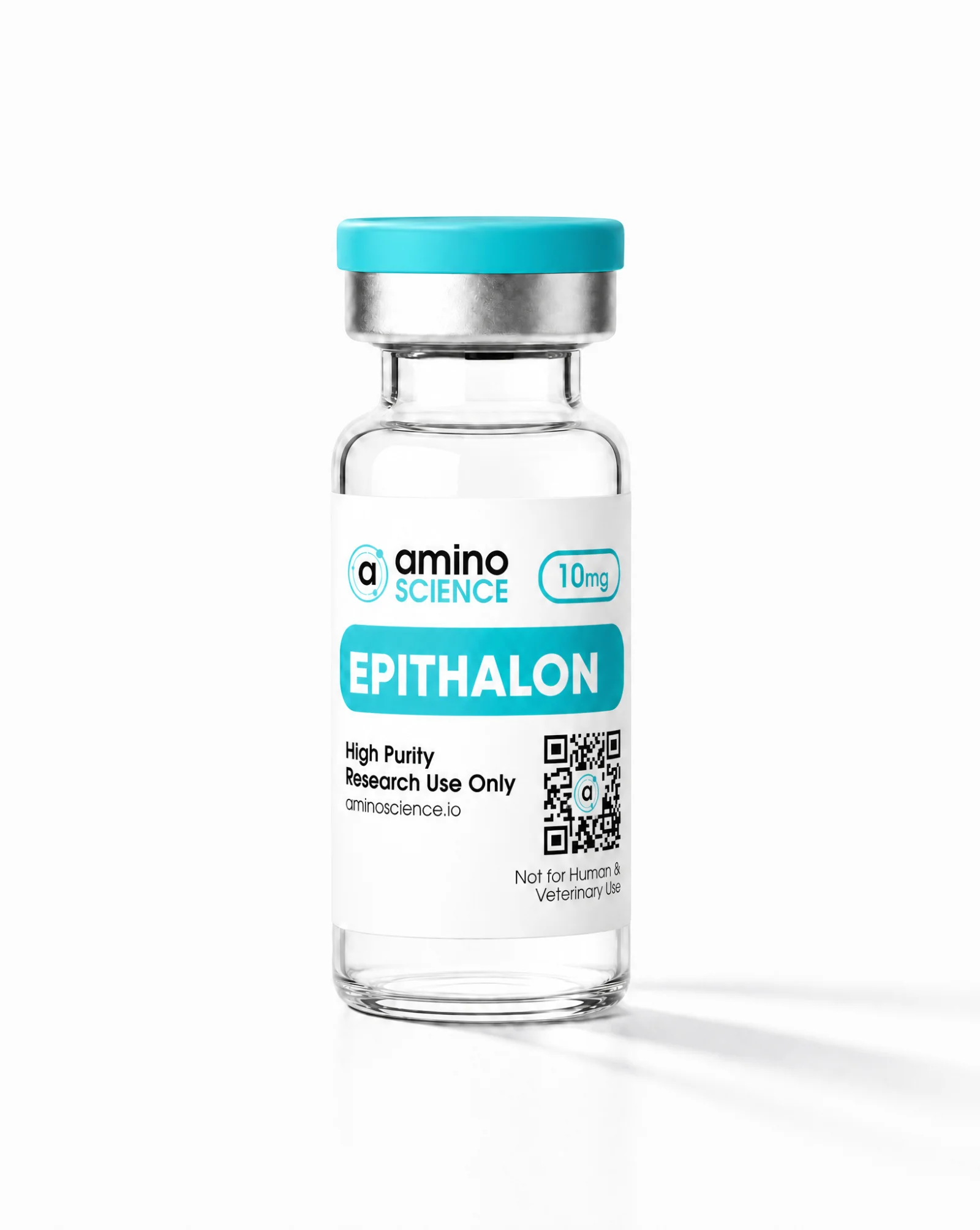
A laboratory reference on the four-residue peptide Epithalon: what has actually been measured in cell-culture and animal models, and how to read a literature base with known limitations.
November 7, 2026·7 min read
Research Use Only
This article is provided for educational and informational purposes only and describes laboratory and preclinical research. The compound discussed is a research chemical intended strictly for in-vitro and laboratory research use, and is NOT for human or animal consumption, diagnostic, or therapeutic use. Nothing here is medical advice or a claim of safety or efficacy. The research summarized is preliminary and ongoing; observations in cell cultures or animal models do not establish outcomes in humans.
What Is Epithalon?
Epithalon, also written Epitalon or Epithalone, is a synthetic tetrapeptide with the sequence Ala-Glu-Asp-Gly (alanyl-glutamyl-aspartyl-glycine), frequently abbreviated AEDG. It carries CAS number 307297-39-8 and the molecular formula C14H22N4O9, giving a molecular weight of roughly 390 g/mol. At four residues it is one of the smallest peptides in regular use as a research compound, and it is produced entirely by solid-phase synthesis.
The sequence was derived as a synthetic analog intended to correspond to the active core of a longer pineal-gland polypeptide preparation studied in the gerontology literature. Because it is so small and so highly polar, it serves as a compact, sequence-defined model compound in aging-related benchwork, where its behavior is markedly easier to control than that of the tissue-derived preparations it was abstracted from.
Research Background
Epithalon belongs to a group commonly referred to as Khavinson peptides, a set of short sequences investigated primarily by a single research group over several decades. This provenance is worth stating plainly, because it shapes how the literature should be read: much of the published work on this compound originates from a concentrated set of laboratories, a substantial portion was published in regional journals, and independent replication outside that group is comparatively limited. None of that makes the observations wrong, but it does mean the evidence base differs in character from that of a compound characterized across many independent laboratories.
What Has Been Studied Preclinically
Published investigations of Epithalon are predominantly in-vitro and animal-model in nature. The most frequently cited line of inquiry concerns telomere biology: cell-culture studies have examined whether exposure is associated with changes in telomerase activity and telomere length in cultured human somatic cell lines. Reported experimental endpoints include:
Cell-culture assays examining telomerase activity and telomere length in cultured human fibroblast and somatic cell lines.
Replicative-senescence and population-doubling studies using the peptide as a tool compound in lifespan-related assays.
Rodent and invertebrate (Drosophila) models reporting lifespan and physiological-biomarker endpoints under controlled laboratory conditions.
Mechanistic work on melatonin, circadian, and gene-expression pathways in pineal-tissue and chromatin models.
These describe observations in laboratory systems only. They do not establish outcomes in humans or animals, and the surrounding body of work is preliminary and ongoing.
Proposed Mechanisms and Their Limits
A recurring hypothesis in the literature is that short peptides of this kind interact directly with DNA or chromatin, influencing gene expression in a sequence-dependent manner. This proposal is mechanistically unusual and has not been resolved to the standard that would be expected for a well-characterized receptor-ligand interaction. Unlike the compounds discussed elsewhere in this series, Epithalon has no established receptor target, and the pathway between exposure and the reported telomerase observations is not mapped.
For researchers, the practical consequence is that Epithalon is best treated as an empirical tool compound rather than a mechanistic probe. Experiments designed around it should include appropriate controls and should not assume a defined molecular target, because none has been established.
Purity, HPLC, and the Certificate of Analysis
A four-residue peptide is synthetically straightforward, and purity figures for Epithalon are typically high. The characterization that matters most here is identity: with only four residues and a low molecular weight of roughly 390 g/mol, mass spectrometry provides a clear confirmation against the theoretical value for C14H22N4O9. Reversed-phase HPLC reports purity, though retention behavior for such a small, highly polar peptide can differ from that of longer sequences on standard columns. The COA also reports actual fill weight.
Standard Laboratory Storage and Handling
Epithalon is highly water-soluble and reconstitutes readily, reflecting its two acidic residues and small size. Lyophilized material stored cold, dry, and dark is stable. The aspartate and glutamate residues make deamidation and backbone hydrolysis the degradation pathways most worth attention in solution, both of which are pH-dependent, so buffer selection is a relevant variable for extended incubations. Standard practice otherwise applies: slow solvent addition down the vial wall, gentle swirling, single-use aliquots, and clear labeling.
Epithalon has no established receptor target, and the mechanism connecting exposure to reported telomerase observations is not mapped. Experiments should include appropriate controls rather than assume a defined molecular pathway. This information describes laboratory procedure only and does not describe or imply any human or veterinary application.
Reading a Literature Base With Limited Independent Replication
Epithalon presents a methodological situation that researchers encounter regularly with compounds from this family, and it is worth addressing directly rather than leaving implicit. A substantial share of the published work originates from a concentrated set of laboratories, a portion appeared in regional journals with varying indexing, and independent replication outside the originating group is limited. These are observations about the shape of the evidence base, not about the honesty of the work.
The practical consequence is that effect sizes reported in such a literature should be treated as upper bounds pending replication, and that designing an experiment around an expected magnitude drawn from those reports carries more risk than it would for a compound characterized across many independent groups. Where a compound is being evaluated as a tool, this argues for including a positive control with an independently established effect, so that a null result can be distinguished from an assay that simply did not work.
The Delivery Question
A specific mechanistic gap deserves attention from anyone designing work with this peptide. The most frequently cited observations concern telomerase activity, which is an intracellular and ultimately nuclear process. Epithalon is a four-residue peptide with two acidic side chains, making it small but highly polar and negatively charged at physiological pH, which is not a profile associated with ready passive diffusion across membranes.
No established transport mechanism accounts for how the intact peptide would reach the compartment where the reported effects occur. This does not invalidate the observations, and several explanations are possible in principle, including fragment uptake, a transporter-mediated route, or an indirect effect initiated at the cell surface. But none has been demonstrated, and the gap is large enough that it should inform experimental design: work that assumes intracellular delivery is assuming something the literature has not established.
Standard Characterization for a Very Small Peptide
Short, highly polar peptides behave differently from longer sequences on standard analytical columns. Epithalon's low molecular weight and high polarity mean it elutes early under typical reversed-phase conditions, sometimes close to the void volume, which can compress the separation between the main peak and polar impurities. Where a purity figure matters, it is worth confirming that the method used was suited to the analyte rather than a generic peptide gradient.
What Remains Under Investigation
The open questions here are more fundamental than for most compounds in this catalog. Whether the reported telomerase effects replicate independently across laboratories, what molecular interaction if any mediates them, how a highly polar tetrapeptide would reach an intracellular or nuclear compartment, and whether the rodent and invertebrate lifespan observations generalize are all unresolved. Researchers working with this peptide should treat the existing literature as a starting point for investigation rather than a settled description.
Frequently asked questions
What is the sequence of Epithalon?
Ala-Glu-Asp-Gly, frequently abbreviated AEDG, a four-residue synthetic tetrapeptide with CAS number 307297-39-8, molecular formula C14H22N4O9, and a molecular weight of roughly 390 g/mol.
What has Epithalon actually been studied for in the laboratory?
Predominantly telomere biology: cell-culture assays examining telomerase activity and telomere length in cultured human somatic cell lines, replicative-senescence and population-doubling studies, rodent and Drosophila lifespan and biomarker endpoints, and work on melatonin, circadian, and gene-expression pathways in pineal-tissue models.
Does Epithalon have a known receptor target?
No. Unlike receptor-targeted research peptides, Epithalon has no established receptor, and the pathway between exposure and the reported telomerase observations is not mapped. A recurring hypothesis proposes direct interaction with DNA or chromatin, but this has not been resolved to the standard expected for a characterized ligand-receptor interaction.
What are Khavinson peptides?
A group of short sequences, including Epithalon, investigated primarily by a single research group over several decades. Much of the published work originates from a concentrated set of laboratories with comparatively limited independent replication, which is relevant context when weighing the evidence base.
What degradation pathways matter for this peptide in solution?
The aspartate and glutamate residues make deamidation and backbone hydrolysis the pathways most worth attention, and both are pH-dependent. Buffer selection is therefore a relevant variable for extended incubations, alongside standard precautions against freeze-thaw cycling.
For research use only. Not for human or veterinary use. This content is educational and summarizes laboratory research; it is not medical advice and makes no health claims.