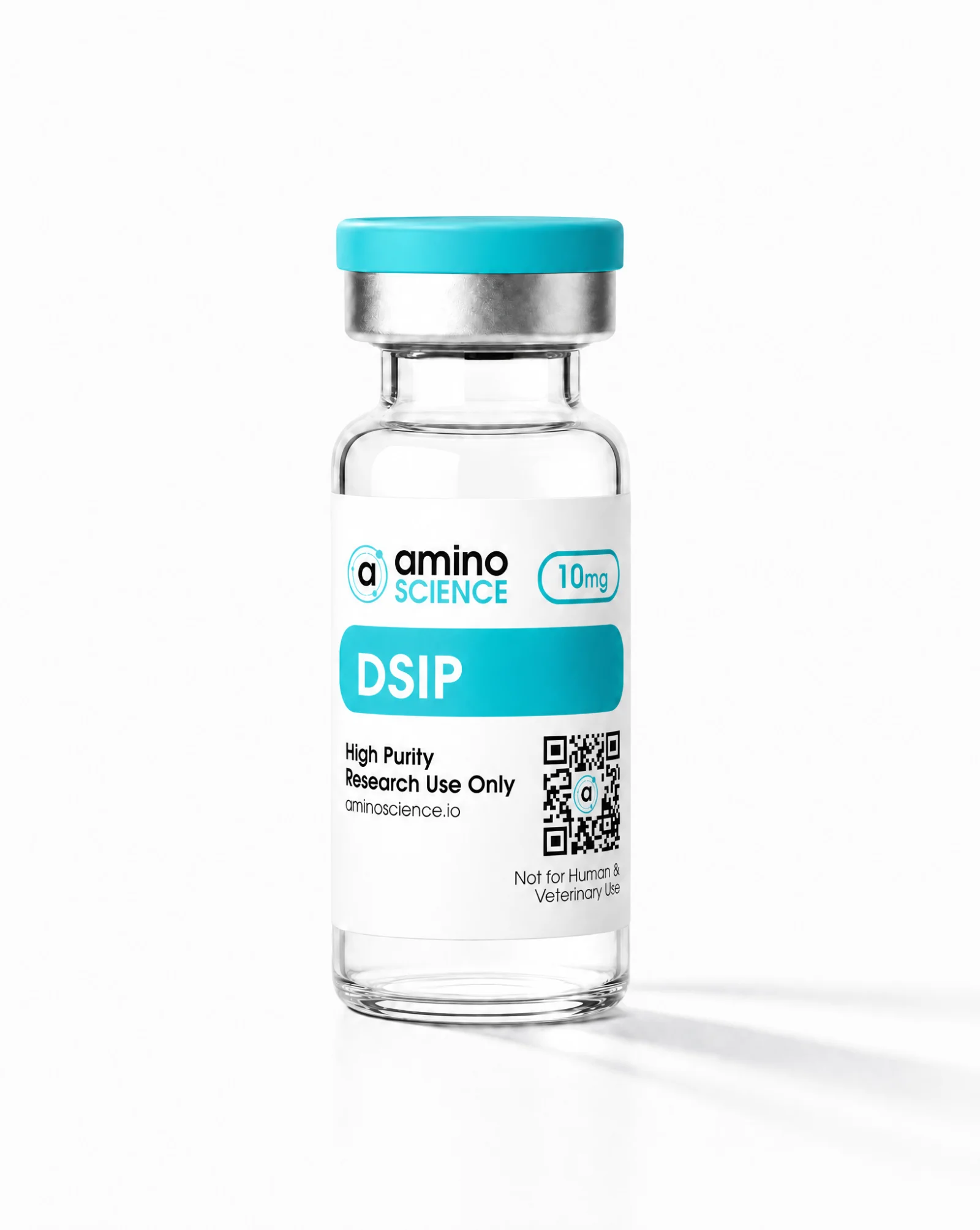
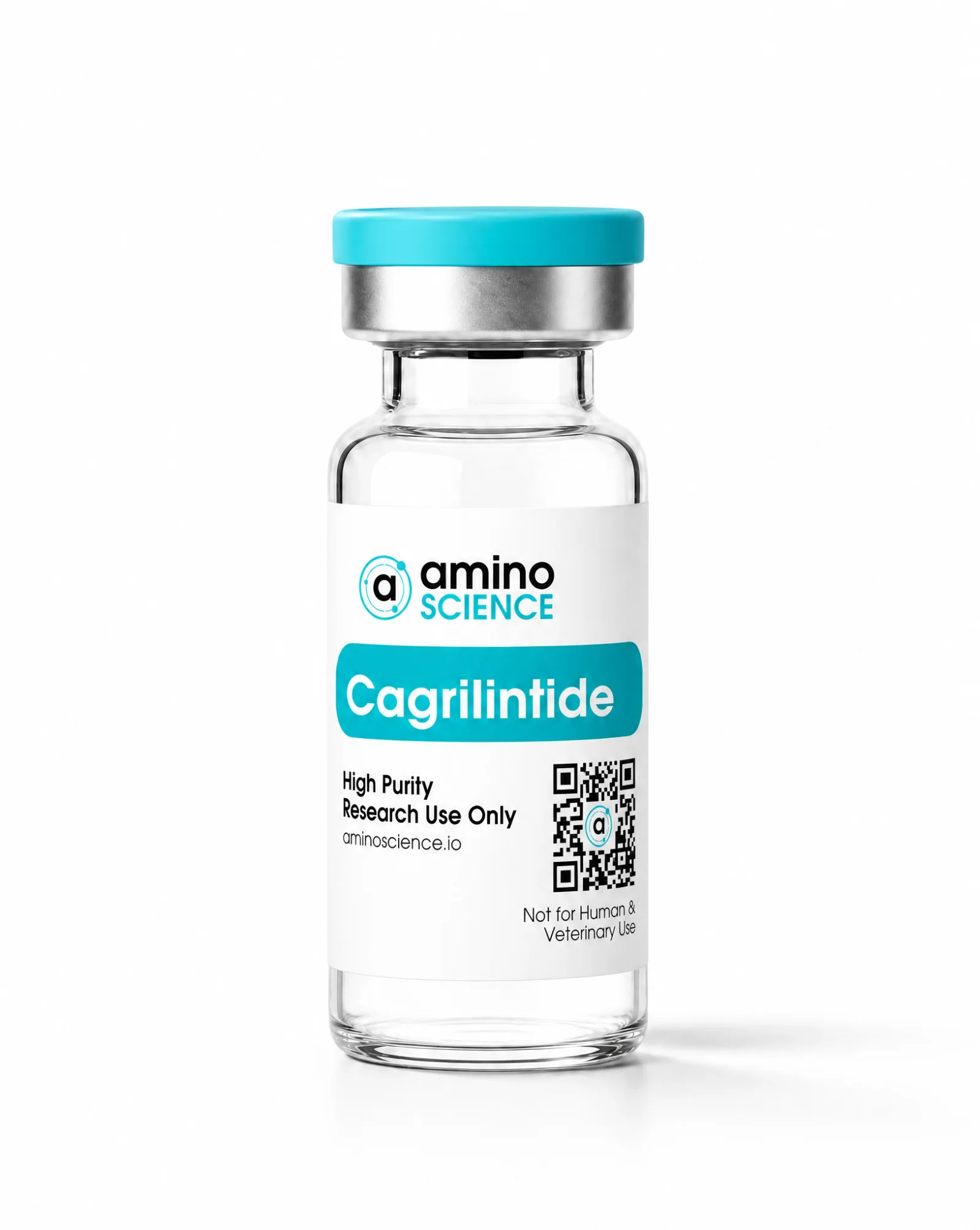
DSIP (10mg): Research Background
Delta Sleep-Inducing Peptide (DSIP) is an endogenous neuropeptide first isolated in 1974 by the Schoenenberger-Monnier group from the cerebral venous blood of rabbits placed in an electrically induced sleep state. It is a nonapeptide with the primary sequence Trp-Ala-Gly-Gly-Asp-Ala-Ser-Gly-Glu (WAGGDASGE), corresponding to the molecular formula C35H48N10O15 and an average molecular weight near 848.8 g/mol (monoisotopic mass approximately 848.34 Da). This listing supplies 10 mg of lyophilized DSIP (CAS 62568-57-4) as a reference material intended strictly for in-vitro and preclinical laboratory investigation. It is not a drug, dietary supplement, or article for human or veterinary use.
The peptide is amphiphilic, carrying both hydrophilic and hydrophobic residues, and reference reports describe its capacity to associate with membrane systems. Because DSIP occurs naturally in mammalian tissue and plasma, it has served primarily as a probe compound in neurochemistry and chronobiology research rather than as a synthetic novelty. Its short chain length and unblocked N- and C-termini make it a convenient model peptide for laboratory work on small-peptide stability, membrane interaction, and receptor-binding assays.
What Has Been Studied
Published preclinical and in-vitro literature on DSIP is exploratory and, in several areas, contradictory — findings should be treated as preliminary and hypothesis-generating rather than established. Reported lines of laboratory investigation include:
- Correlation studies examining DSIP-like immunoreactivity in plasma and cerebrospinal fluid against circadian and sleep-associated rhythms in animal and human sampling models.
- Electrophysiological and behavioral rodent models exploring the peptide's original delta-wave-modulating characterization, with mixed reproducibility across laboratories.
- In-vitro work on blood-brain-barrier permeability and gut absorption used to characterize how small amphiphilic peptides distribute across biological membranes.
- Biochemical assays probing possible interactions with neuroendocrine and stress-axis signaling pathways in isolated tissue and cell preparations.
- Analytical and formulation studies using DSIP as a model substrate for peptide degradation, oxidation of the tryptophan residue, and enzymatic cleavage kinetics.
This material is sold for laboratory research use only. Nothing here constitutes medical advice or a health claim, and DSIP is not intended to diagnose, treat, cure, or prevent any condition. Handling should follow standard laboratory practice for lyophilized peptides.
Analytical Characterization
Each batch of DSIP (10mg) is characterized to a labeled purity of at least 98%. Reversed-phase high-performance liquid chromatography (RP-HPLC) is used to quantify chromatographic purity and to resolve related peptide impurities, deletion sequences, and oxidation products from the main peak. Identity is confirmed by mass spectrometry (ESI-MS or MALDI-TOF), with the observed mass compared against the theoretical value derived from the molecular formula C35H48N10O15 to verify the intended nonapeptide sequence.
A batch-specific Certificate of Analysis (COA) is available and typically documents HPLC purity, the mass-spectrometry identity result, peptide content, and appearance. Researchers verifying incoming material can cross-reference the reported mass and retention profile against the COA lot number. As with other small peptides containing a tryptophan residue, DSIP is best protected from prolonged light and oxidative exposure during weighing and reconstitution to preserve analytical integrity for downstream assay work.