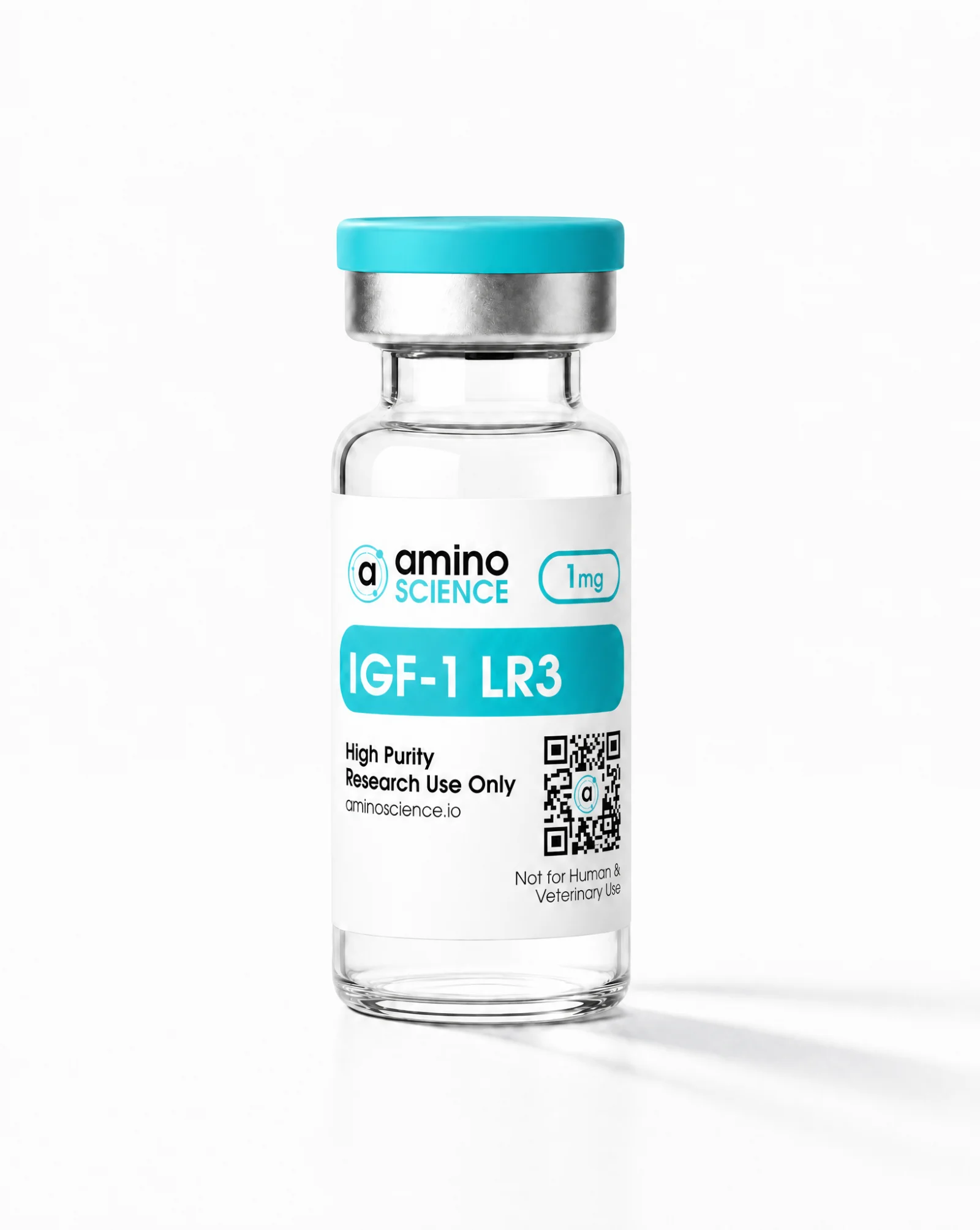
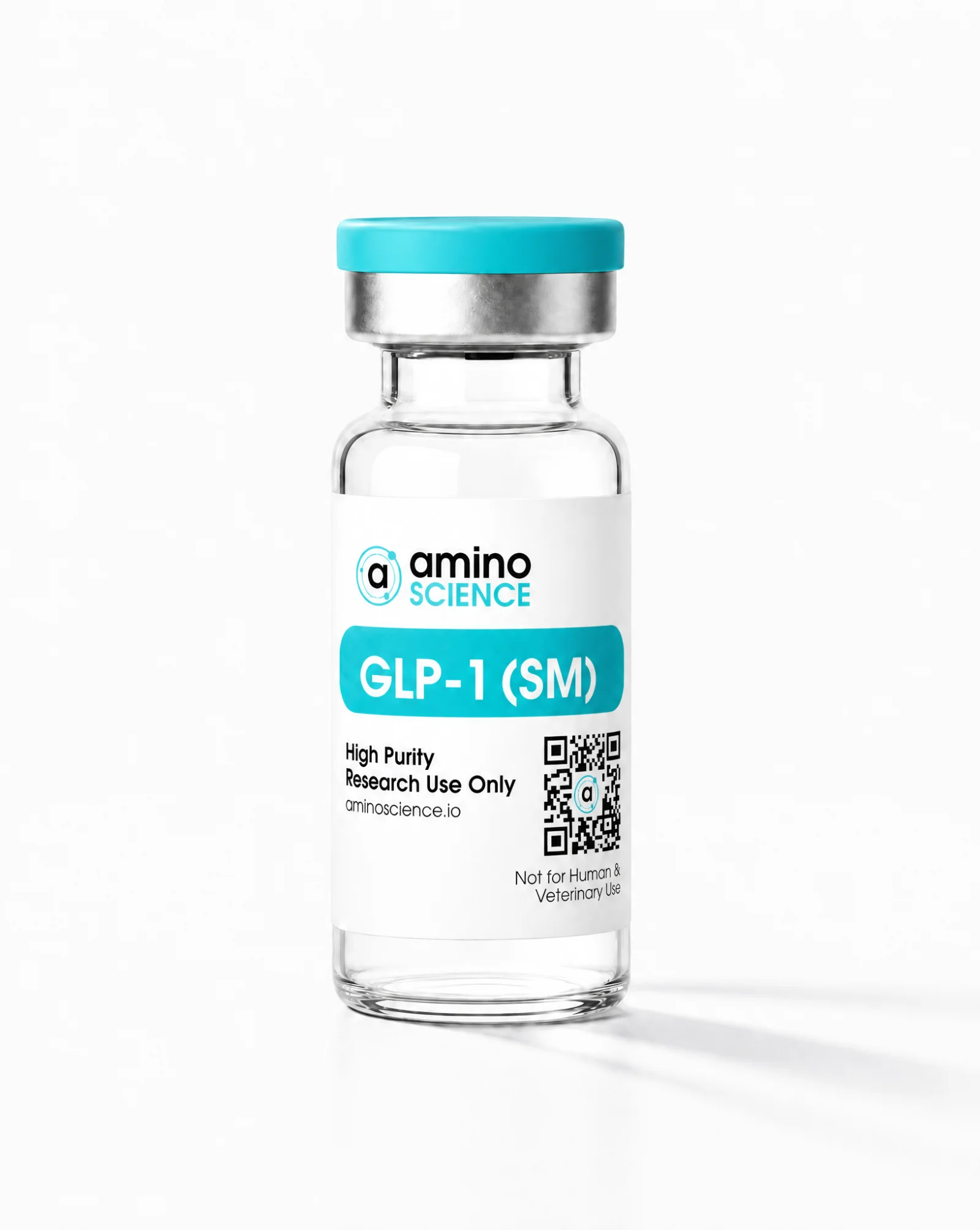
IGF-1 LR3 Research Background
This listing supplies IGF-1 LR3 (Long R3 IGF-1) as a lyophilized reference material for in-vitro and preclinical laboratory work. IGF-1 LR3 is an 83-residue recombinant analog of human insulin-like growth factor 1, engineered with two structural modifications relative to the native 70-amino-acid protein: a 13-residue N-terminal extension and an arginine substitution at position 3 (in place of the native glutamic acid). These changes are the reason for the "Long" and "R3" in the name. The material is catalogued under CAS 946870-92-4 with the molecular formula C400H625N111O115S9, and each research lot is supplied at a documented purity of ≥98%. Because it is a folded, disulfide-bonded polypeptide rather than a short linear peptide, laboratories treat it as a recombinant protein standard when planning identity confirmation, reconstitution, and cold-chain storage.
The defining feature studied in the literature is that the position-3 substitution markedly lowers the analog's affinity for insulin-like growth factor binding proteins (IGFBPs). In native IGF-1 systems, IGFBPs sequester much of the free protein; the reduced binding of the R3 variant is the property that makes it a useful tool compound for researchers isolating receptor-level signaling from binding-protein modulation in cell-culture systems. All descriptions here concern the research substance itself and its documented study history — not outcomes in humans or animals. The body of work remains preliminary and ongoing, and nothing on this page constitutes medical advice.
What Has Been Studied in Preclinical Models
Published investigations involving IGF-1 LR3 are predominantly in-vitro and cell-culture in nature, where the analog is frequently used as a supplement to serum-free culture media and as a probe of IGF-1 receptor (IGF-1R) signaling. Because of its diminished IGFBP affinity, it is a common reference agonist in studies dissecting downstream pathways such as PI3K/Akt and MAPK/ERK cascades under controlled conditions.
- Cell-culture and bioprocess systems, where recombinant IGF-1 analogs are studied as media components in relation to cell proliferation and viability endpoints in vitro.
- Receptor-signaling assays characterizing IGF-1R engagement and downstream phosphorylation events (e.g., Akt, ERK).
- Comparative binding-protein studies contrasting the R3 variant with native IGF-1 to isolate IGFBP-independent responses.
- Model systems examining protein synthesis, differentiation, and apoptosis endpoints in cultured cell lines.
These references describe experimental laboratory work only. They are not medical claims, are not evidence of safety or efficacy in humans or animals, and should not be interpreted as guidance for any use outside a controlled research environment.
Analytical Characterization
Each research lot is supplied as a lyophilized powder and characterized before release. Because IGF-1 LR3 is a larger, folded protein than a typical short peptide, identity and purity are established using orthogonal analytical methods so the material described on the Certificate of Analysis (COA) matches the sequence, mass, and disulfide-folded structure expected for the Long R3 analog. This dual-method approach separates purity (how much of the sample is the target protein) from identity (confirmation that the target is the correct molecule).
- RP-HPLC purity: quantified by peak-area integration, with lot purity reported on the COA at ≥98%. The chromatogram resolves the main peak from process-related impurities, misfolded species, and truncated sequences.
- Mass-spectrometry identity: ESI-MS or MALDI-TOF confirms the observed average mass against the theoretical value derived from formula C400H625N111O115S9, verifying molecular identity.
- Supporting data: appearance, net protein content, and residual moisture or endotoxin checks where applicable to the recombinant material.
The COA accompanying each product is the definitive analytical record for that specific lot. Because purity and mass can vary slightly between production batches of a recombinant protein, researchers should reference the COA tied to the lot number received rather than generic specifications when documenting experimental inputs. Retaining the COA alongside experimental records supports reproducibility and traceability.
Laboratory Handling of Lyophilized Material
As a lyophilized recombinant protein, IGF-1 LR3 is sensitive to moisture and to repeated temperature cycling, both of which can compromise the folded, disulfide-bonded structure. Standard laboratory practice is to allow sealed vials to equilibrate to room temperature before opening to minimize condensation, and to reconstitute gently with an appropriate research-grade solvent under aseptic technique, avoiding vigorous vortexing that can shear or denature the protein. Aliquoting reconstituted stock into single-use portions limits freeze-thaw cycles that degrade protein integrity. Detailed temperature and stability windows for lyophilized, reconstituted, and working solutions appear in the storage table on this page.