About This Research Material
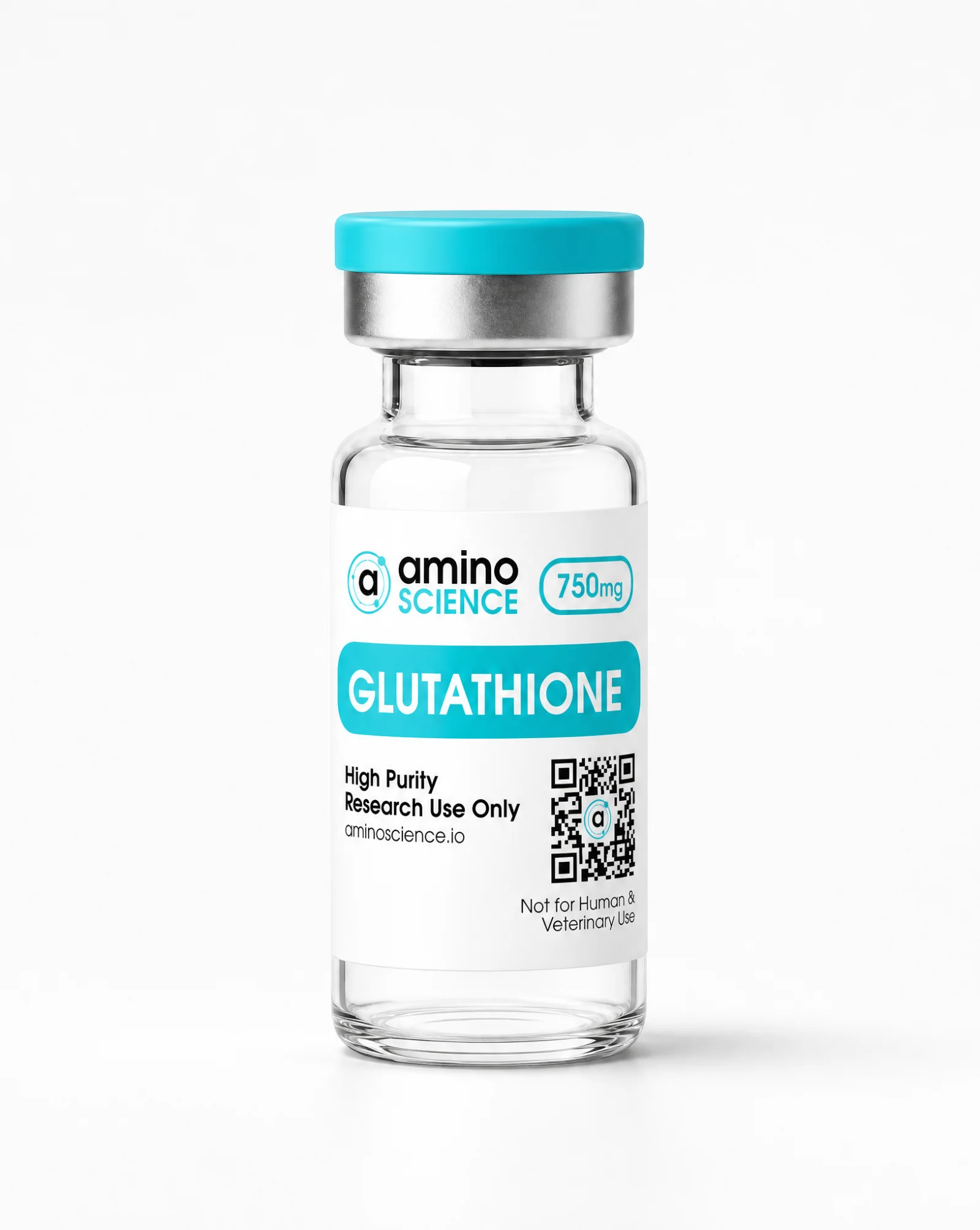
This listing supplies reduced glutathione (GSH) as a lyophilized reference material for in-vitro and preclinical laboratory work, presented at a 750 mg fill weight per vial. Glutathione is a tripeptide (C10H17N3O6S, CAS 70-18-8) built from three amino-acid residues — glutamine/glutamate, cysteine, and glycine — but it is not a conventional linear peptide. Its defining structural feature is an unusual gamma-glutamyl bond: the first residue is linked through the side-chain carboxyl rather than the alpha-carboxyl, a connectivity that makes the molecule resistant to standard aminopeptidases and gives it distinct chemistry from ordinary tripeptides. Laboratories therefore treat it as a thiol-bearing redox reagent rather than as a simple sequence peptide.
The functional center of the molecule is the free sulfhydryl (–SH) group contributed by the cysteine residue. This thiol is what makes glutathione a widely cited model redox reagent in bench research: it can be reversibly oxidized to the disulfide dimer GSSG, and the GSH/GSSG couple is used across many assay systems as a defined redox reference. Everything below concerns the research substance itself — its documented study history and its analytical fingerprint — and is not a statement about outcomes in humans or animals.
What Has Been Studied in the Laboratory
Glutathione is one of the most extensively characterized small molecules in cell biology, and the published work surrounding it is overwhelmingly in-vitro and preclinical. In cell-culture and biochemical systems it is frequently employed as a defined thiol source and as a component of the glutathione redox couple used to poise assay conditions. Reported experimental lines of inquiry include its role in enzyme-catalyzed conjugation reactions (glutathione-S-transferase assays), its interaction with the glutathione peroxidase and glutathione reductase enzyme systems, and its use as a standard in analytical methods that quantify intracellular thiol status. These are descriptions of laboratory systems only and are not evidence of any effect in humans or animals.
- Redox-buffer preparations using defined GSH/GSSG ratios in biochemical and cell-free assays.
- Glutathione-S-transferase (GST) conjugation studies and affinity-tag purification chemistry.
- Characterization of glutathione peroxidase and reductase enzyme activity in vitro.
- Use as an analytical reference standard for thiol quantification (e.g., HPLC and Ellman/DTNB-based methods).
These references describe experimental laboratory work only. They are not medical claims, are not evidence of safety or efficacy in humans or animals, and should not be interpreted as guidance for any use outside a controlled research environment. This research is preliminary and ongoing, and nothing here is medical advice.
Analytical Characterization
Each research lot is supplied as an off-white to white crystalline lyophilized solid and characterized before release, with results recorded on a lot-specific Certificate of Analysis (COA). Because glutathione is defined by its reactive thiol, analytical release emphasizes both purity of the target molecule and the redox state of that thiol — a sample partially oxidized to GSSG is chemically distinct even when the peptide backbone is intact.
- HPLC purity: reversed-phase or ion-pairing HPLC quantifies the main GSH peak by peak-area integration, with lot purity reported on the COA (specified ≥99%). The chromatogram resolves reduced glutathione from the oxidized GSSG dimer and process-related impurities.
- Mass-spectrometry identity: ESI-MS or a comparable method confirms the observed mass against the theoretical value for C10H17N3O6S, verifying molecular identity independent of the purity measurement.
- Supporting data: appearance, and where applicable water/residual-solvent content and titrimetric assay of the free thiol.
The COA tied to the specific lot number received is the definitive analytical record for that material. Because purity and residual oxidized content can vary slightly between manufacturing batches, researchers should cite the lot COA rather than generic specifications when documenting experimental inputs, and retain it alongside experimental records to support reproducibility and traceability.
Laboratory Handling of the Thiol Reagent
The reactivity that makes glutathione useful also makes it sensitive: the free thiol oxidizes on exposure to air, moisture, elevated temperature, and trace transition-metal ions. Standard laboratory practice is to allow sealed vials to equilibrate to room temperature before opening to limit condensation on the hygroscopic solid, and to prepare working solutions fresh in oxygen-poor, appropriately buffered research-grade solvent. Freshly prepared solutions are preferred because aqueous glutathione oxidizes over time; aliquoting and minimizing headspace air help preserve the reduced form. Specific temperature and stability windows for the solid and reconstituted solutions appear in the storage table on this page.