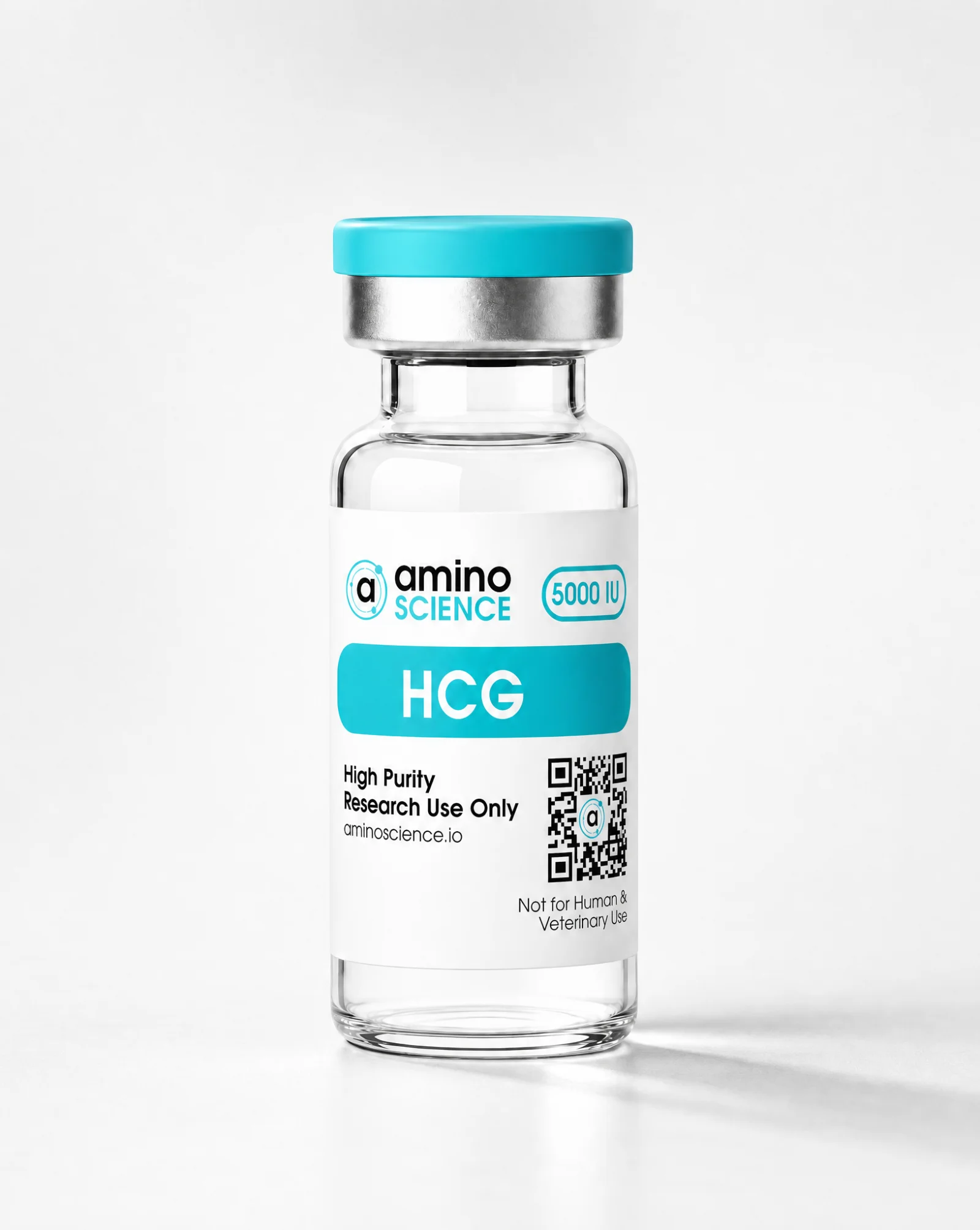
HCG (5000 IU) Research Background
Human chorionic gonadotropin (HCG; CAS 9002-61-3) is supplied here strictly for analytical and in-vitro laboratory research. Unlike the short synthetic peptides commonly stocked for benchtop work, HCG is a large, heterodimeric glycoprotein hormone comprising roughly 237 amino acids distributed across two non-covalently associated subunits: an alpha subunit shared with other pituitary glycoprotein hormones, and a beta subunit that confers the molecule's distinct identity. A defining structural feature is its extensive glycosylation — both N-linked and O-linked oligosaccharide chains attached along the protein backbone — which is why HCG behaves as a glycoprotein rather than a simple linear peptide in solution. Because in-vitro receptor activity depends on the intact, correctly paired heterodimer, researchers treat subunit association and carbohydrate integrity as central variables when planning identity checks, reconstitution, and storage.
Interest in HCG as a research material centers on its role as a well-characterized reference ligand for the luteinizing-hormone/chorionic-gonadotropin receptor (LHCGR), a class-A G-protein-coupled receptor. Its activity is reported in International Units (IU), a bioassay-referenced measure appropriate for a heterogeneous glycoprotein whose potency cannot be captured by mass alone; this listing is standardized to 5000 IU per vial. The body of published work surrounding HCG is extensive but remains, for the purposes of this material, a laboratory and preclinical reference point only. Findings from cell-based receptor assays and animal-model studies are preliminary in the context of any novel investigation and should not be extrapolated to human or animal outcomes. Nothing here constitutes medical advice.
What Has Been Studied in Preclinical and In-Vitro Models
Published investigations involving HCG are predominantly in-vitro receptor-pharmacology and rodent-model in nature. Reported experimental lines of inquiry include use of HCG as an agonist standard in cultured cells expressing the LHCGR, cyclic-AMP accumulation and second-messenger signaling assays, and steroidogenesis endpoints measured in isolated cell systems. It is also frequently used as a calibrated reference antigen in immunoassay development and validation. This research is preliminary and ongoing and describes laboratory systems only.
- Receptor-binding and functional assays in cell lines heterologously expressing LHCGR, using HCG as an agonist reference.
- cAMP and downstream second-messenger signaling studies characterizing Gs-coupled receptor activation in vitro.
- Steroidogenesis assays in cultured Leydig or granulosa-type cell models measuring pathway activation.
- Immunoassay calibration and cross-reactivity work, where HCG and its free beta subunit serve as characterized analytical standards.
These references describe experimental laboratory work only. They are not medical claims, are not evidence of safety or efficacy in humans or animals, and should not be interpreted as guidance for any use outside a controlled research environment.
Analytical Characterization
Each research lot is characterized before release so that the material described on the Certificate of Analysis (COA) matches the properties expected for a glycoprotein hormone. Characterizing a glycosylated heterodimer differs from characterizing a small synthetic peptide: mass is intrinsically heterogeneous because of variable glycan occupancy, so purity is assessed by chromatographic and electrophoretic profiling rather than by a single exact-mass value, and potency is expressed in IU against a bioassay-referenced standard. This lot is specified at ≥98% purity and 5000 IU.
- HPLC (RP-HPLC / SEC): purity reported by peak-area integration on the COA (≥98%), with size-exclusion profiling used to confirm the intact heterodimer and resolve aggregated or dissociated-subunit species.
- Mass spectrometry / SDS-PAGE identity: ESI or MALDI-TOF and gel electrophoresis characterize the glycoprotein and its alpha/beta subunits; the observed mass distribution reflects expected glycan heterogeneity rather than a single sharp value.
- Potency reference: activity standardized in International Units (5000 IU) against a reference preparation, the appropriate potency metric for a glycoprotein hormone.
- Supporting data: appearance, net protein content, and residual moisture or water-content checks where applicable.
The COA accompanying each product is the definitive analytical record for that specific lot. Because glycan composition, potency, and purity can vary slightly between production batches, researchers should reference the COA tied to the lot number received rather than generic specifications when documenting experimental inputs. Retaining the COA alongside experimental records supports reproducibility and traceability across assays that depend on a defined IU input.
Laboratory Handling of Lyophilized Glycoprotein
As a lyophilized glycoprotein, HCG is hygroscopic and sensitive to heat, agitation, and repeated temperature cycling, any of which can promote subunit dissociation or aggregation and reduce measurable IU. Standard laboratory practice is to allow the sealed vial to equilibrate to room temperature before opening to minimize condensation, then to reconstitute gently with an appropriate research-grade aqueous solvent under aseptic technique — avoiding vigorous vortexing that can shear a large protein. Aliquoting reconstituted stock into single-use portions limits freeze-thaw cycles that degrade glycoprotein integrity. Detailed temperature and stability windows for lyophilized, reconstituted, and working solutions appear in the storage table on this page. These are standard laboratory handling notes only.