Amino Science Labs sells research peptides exclusively to qualified researchers and laboratories for in vitro and laboratory use. Please confirm before continuing.
By proceeding you affirm the statements above are true. Products are not for human or veterinary use, not for use in diagnostic procedures, and have not been evaluated by the U.S. Food and Drug Administration. Full disclaimer.
🔥 FREE SHIPPING ON ORDERS OVER $250 🔥
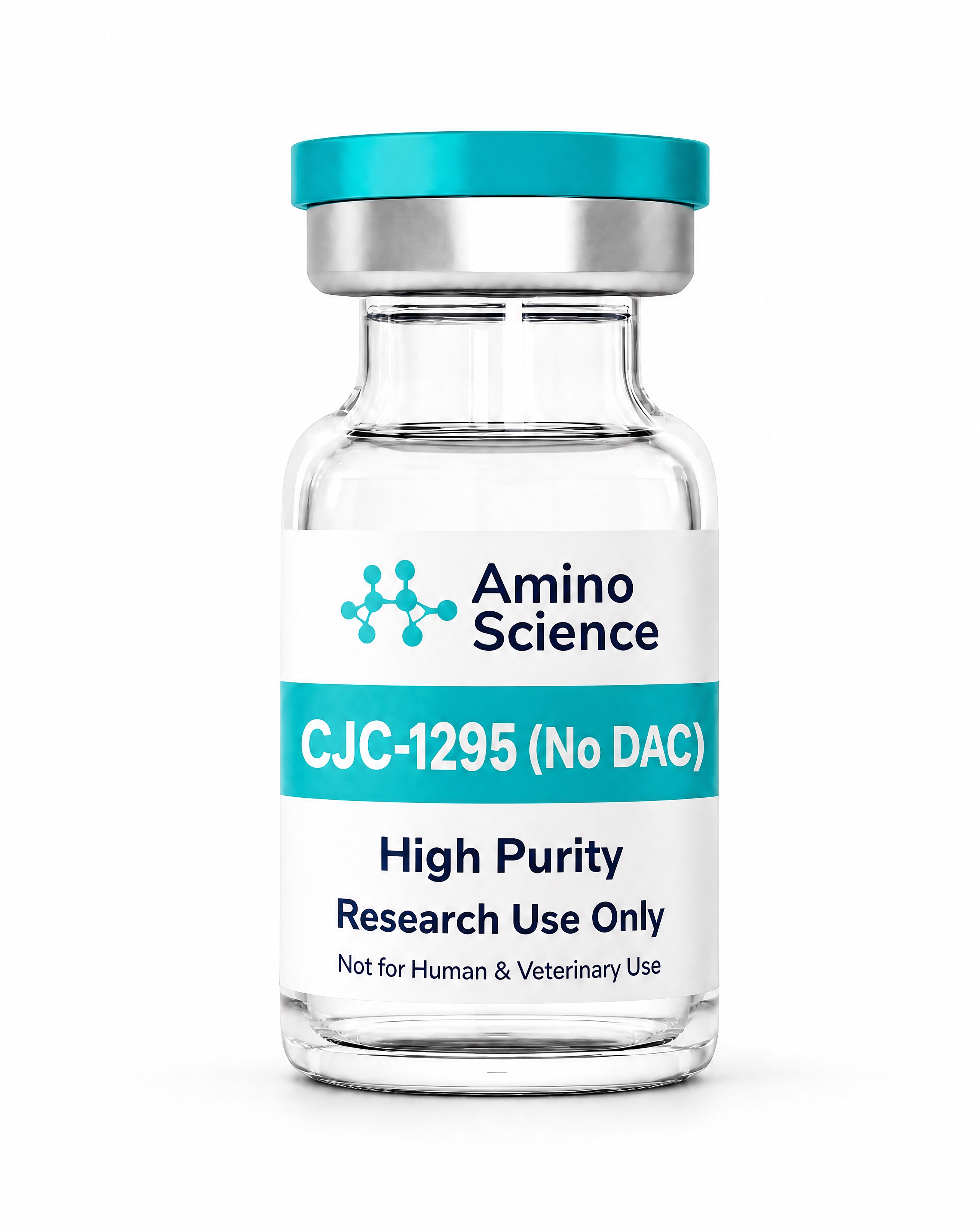
Research Peptide
CJC-1295 is a synthetic analogue of growth hormone-releasing hormone (GHRH). This version is without Drug Affinity Complex. For Research Use Only.
Fast shipping
Same-day dispatch
Third-party tested
U.S. accredited labs
99%+ purity
HPLC verified
29AA
SEQUENCE
Modified GHRH(1-29) analogue
30min
HALF-LIFE
Without DAC conjugation
2-10x
GH INCREASE
Dose-dependent pulsatile release
45+
PUBLICATIONS
In GH axis research
3368Da
MOL. WEIGHT
Tetrasubstituted GHRH analogue
Free shipping
on orders over $150
Quality guarantee
99%+ purity verified
Secure checkout
256-bit SSL encryption
Research
This listing supplies CJC-1295 (No DAC) as a lyophilized (freeze-dried) research peptide for in-vitro and preclinical laboratory work only. CJC-1295 is a synthetic analogue of growth-hormone-releasing hormone (GHRH), built on the biologically active N-terminal GHRH(1-29) fragment rather than the full 44-residue hormone. It carries a defined set of amino-acid substitutions relative to the native sequence, and in the literature this stabilized 1-29 backbone is frequently referred to as modified GRF(1-29). The substitutions were introduced to reduce recognition by dipeptidyl peptidase-IV (DPP-IV) and to limit backbone oxidation and cleavage, giving the peptide greater measurable stability than the unmodified GHRH fragment in experimental systems. With the molecular formula C152H252N44O42 (CAS 863288-34-0), it is offered here as a characterized reference compound at a purity of at least 98%.
The defining feature of this particular listing is that it is supplied without the Drug Affinity Complex — the "No DAC" form. The DAC version of CJC-1295 bears an additional reactive maleimido-lysine moiety engineered to bind covalently to albumin in experimental systems, which markedly extends its measurable half-life in preclinical assays. This No DAC material omits that albumin-binding group entirely, so its behavior in bench assays is that of a stabilized short GHRH analogue with a comparatively brief in-vitro persistence rather than a long-circulating conjugate. Researchers selecting between the two forms typically do so precisely on the basis of this half-life distinction, which is why the No DAC designation is treated as a substantive property of the compound and not a naming footnote.
As a GHRH-receptor agonist tool compound, CJC-1295 (No DAC) appears in the preclinical and in-vitro literature primarily in the context of receptor pharmacology and enzymatic-stability characterization. The themes below are described strictly as observations in laboratory model systems, not as outcomes in humans or animals.
Research Context
These references describe experimental laboratory work only. They are not medical claims, are not evidence of safety or efficacy in humans or animals, and should not be interpreted as guidance for any use outside a controlled research environment. The research surrounding this compound is preliminary and ongoing, and the information here is educational, not medical advice.
Because this is a substituted, mid-length peptide, analytical verification confirms both sequence fidelity and the correct set of stabilizing substitutions rather than an unmodified backbone. Research-grade CJC-1295 (No DAC) is typically assessed by reversed-phase high-performance liquid chromatography (RP-HPLC), with purity reported as the percentage of the main chromatographic peak and the primary peak resolved from process-related impurities and truncated sequences. Mass spectrometry (commonly ESI-MS or MALDI-TOF) is used to confirm that the measured molecular mass matches the theoretical value for the C152H252N44O42 composition (an average mass in the region of 3367 g/mol), verifying molecular identity and distinguishing the modified analogue from the native fragment.
A lot-specific Certificate of Analysis (COA) documents these analyses. Because a lyophilized peptide vial also contains counter-ion (typically acetate) and residual water alongside the peptide, the net peptide content can differ from the gross fill weight, which directly affects concentration calculations. Reviewers should confirm the reported HPLC purity and chromatogram, the mass-spectrometry identity confirmation, and — importantly for this listing — that the characterized material is the No DAC peptide rather than the DAC conjugate, which carries a different mass. Matching these figures to the lot in hand before use, and retaining the COA alongside experimental records, supports reproducibility and traceability.
The following describes conventional handling of lyophilized research peptides and is not instruction for human or animal use. The dry powder is hygroscopic and sensitive to repeated temperature cycling, so sealed vials are commonly kept cold and desiccated and allowed to equilibrate to room temperature before opening to minimize condensation. Reconstitution is performed with an appropriate research-grade solvent under aseptic technique, and stock is typically aliquoted into single-use portions to limit freeze-thaw cycles that can degrade peptide integrity. Reconstituted solutions of a peptide of this length are less stable than the freeze-dried form and are generally kept cold and used within a limited, empirically confirmed window. Specific temperature and time conditions for lyophilized, reconstituted, and working solutions appear in the storage table on this page.
"No DAC" means the peptide is supplied without the Drug Affinity Complex — the reactive maleimido-lysine group that, in the DAC version, binds covalently to albumin in experimental systems to greatly extend measurable half-life. This No DAC form omits that albumin-binding moiety, so in laboratory systems it behaves as a stabilized short GHRH(1-29) analogue with comparatively brief in-vitro persistence. The distinction is a substantive property of the compound, which is why researchers choose between the two forms based on it.
CJC-1295 is based on the shorter, biologically active GHRH(1-29) fragment carrying stabilizing amino-acid substitutions that resist DPP-IV cleavage, whereas native GHRH is the full 44-residue hormone. Tesamorelin, by contrast, retains the full GHRH(1-44) sequence and is stabilized by an N-terminal trans-3-hexenoyl modification. All three are studied as GHRH-receptor tool compounds, but they differ in length and in the specific structural strategy used to slow enzymatic degradation.
It is characterized in vitro as an agonist at the GHRH receptor, a G-protein-coupled receptor on pituitary somatotrophs, with downstream cyclic-AMP signaling used as an experimental endpoint. Additional research examines its enzymatic stability versus the unmodified GHRH(1-29) fragment and its shorter persistence relative to the DAC conjugate. These are mechanistic, model-based observations from preliminary research and do not establish any effect in humans or animals.
Purity is typically assessed by reversed-phase HPLC and reported as a percentage of the main chromatographic peak (this listing is specified at ≥98%), while mass spectrometry (ESI-MS or MALDI-TOF) confirms the molecular mass against the theoretical value for the C152H252N44O42 composition. The mass check also helps confirm that the material is the No DAC peptide rather than the higher-mass DAC conjugate. A lot-specific Certificate of Analysis records these results together with net peptide content.
This product is sold strictly for in-vitro research and laboratory use only. It is not intended for human or animal consumption, diagnostic purposes, or therapeutic application.
By purchasing this product, you confirm that you are a qualified researcher operating within an appropriate laboratory environment and will use this compound in accordance with all applicable local, state, and federal regulations.
Amino Science Labs assumes no liability for misuse of this product outside of its intended research application.
A lyophilized peptide vial contains counter-ion (usually acetate) and residual water in addition to the peptide, so the net peptide mass can be lower than the gross fill weight. Reviewing the lot-matched COA for reported net peptide content and HPLC purity lets researchers calculate accurate stock concentrations, which is essential for reproducible in-vitro work and for correctly comparing results across batches.
No. This material is a research chemical supplied strictly for in-vitro and preclinical laboratory research by qualified researchers. It is not a drug, supplement, or food, is not intended for human or animal consumption or for any diagnostic or therapeutic purpose, and nothing on this page constitutes medical advice or a claim of safety or efficacy.