AOD-9604 Research Background
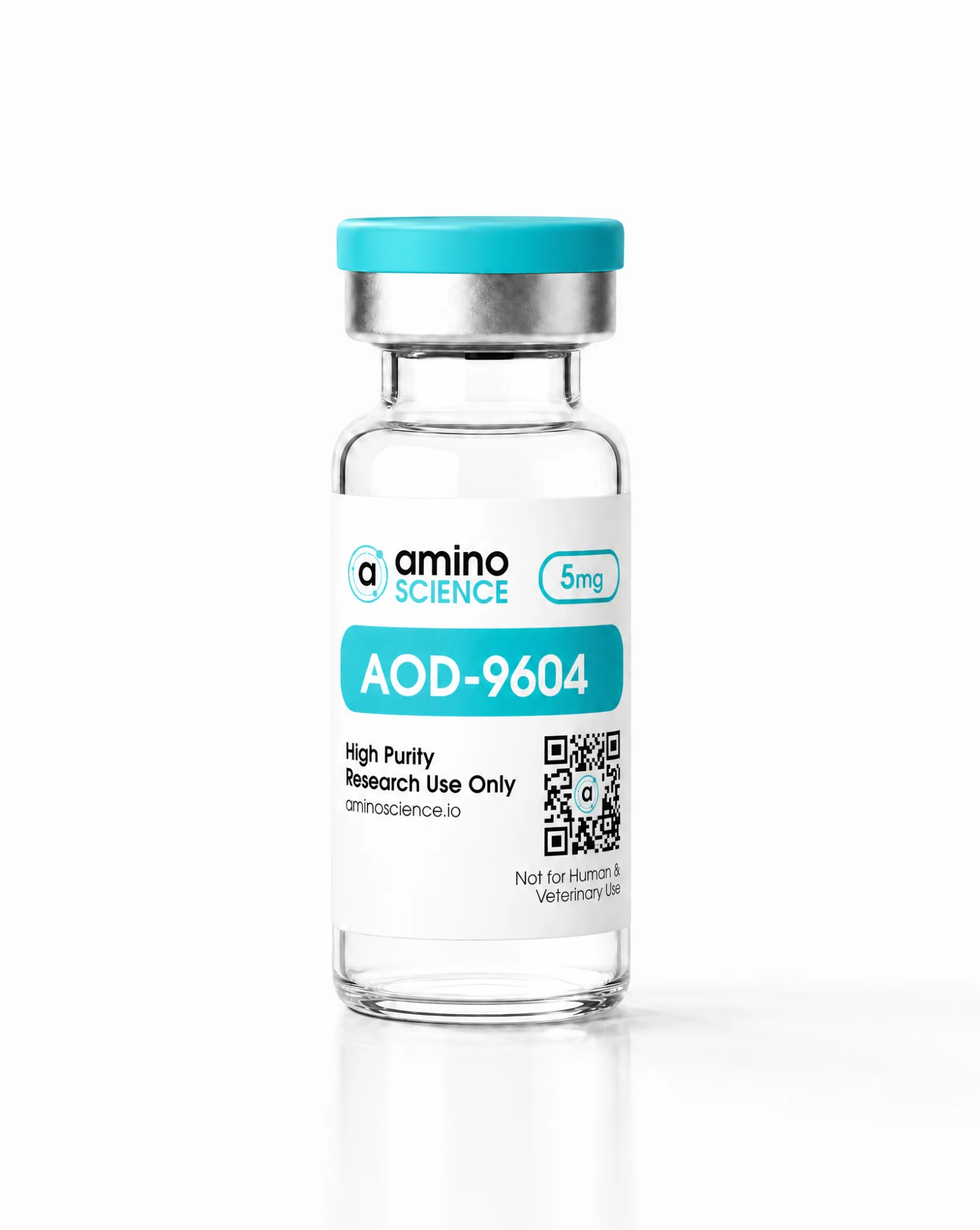
AOD-9604 is a synthetic 16-amino-acid peptide that corresponds to the C-terminal fragment (residues 176–191) of the human growth hormone molecule, with a tyrosine added at the N-terminus to stabilize the sequence. Because it reproduces only this terminal region rather than the full hormone, it is studied in the research literature as a metabolic peptide fragment distinct from intact growth hormone. Cataloged under CAS 221231-10-3 with the molecular formula C78H123N23O23S2 and an average mass near 1815 Da, this 5 mg presentation is supplied as a lyophilized reference material for in-vitro and preclinical laboratory research use only.
Investigational interest in AOD-9604 stems from how a short C-terminal hGH fragment behaves in adipose and metabolic model systems while lacking the full-length hormone's growth-signaling domains. The compound has no established consumer application, and the surrounding body of work remains preliminary and ongoing. Data generated in cell-based and animal-model systems characterize the material's laboratory behavior and should not be extrapolated to human or animal outcomes.
What Has Been Studied in Preclinical Models
Reported experimental work with AOD-9604 has centered on lipid-metabolism model systems. Datasets in the published preclinical record have examined the fragment's association with adipose-tissue lipolytic activity and reported changes in beta-3 adrenergic receptor expression in fat-cell models. A recurring observation described across these studies is that measured signals on fat-metabolism endpoints were reported without corresponding changes to insulin sensitivity, glucose tolerance, or circulating IGF-1 in the model systems examined, a profile the literature contrasts with that of intact growth hormone. These are descriptions of experimental observations in laboratory systems, not statements of effect in humans or animals.
- Adipocyte and adipose-tissue models probing lipolytic-pathway activity.
- Studies of beta-3 adrenergic receptor expression in fat-cell systems.
- Metabolic-marker panels assessing glucose, insulin, and IGF-1 responses in laboratory settings.
- Cartilage and joint-repair models, including preparations combining the peptide with hyaluronic acid, examined in osteoarthritis-relevant preclinical systems.
Separate lines of investigation have used AOD-9604 in cartilage-model and joint-repair systems, where it has been studied alone and in combination with hyaluronic acid as a matrix component. These descriptions summarize laboratory research observations only and do not establish safety, efficacy, or any outcome for any use.
The studies referenced here describe experimental research findings in laboratory systems, not consumer outcomes. They are not medical claims, do not establish safety or efficacy for any use, and must not be interpreted as guidance for administration to humans or animals. This material is for in-vitro laboratory research only, and nothing on this page constitutes medical advice.
Analytical Characterization
Each research lot of AOD-9604 is supplied as a lyophilized powder characterized to ≥98% purity before release. Identity and purity are established with orthogonal analytical methods so that the Certificate of Analysis (COA) reflects both how much of the sample is the target 16-residue peptide and confirmation that the target molecule is correct. Because AOD-9604 contains two cysteine-derived sulfur atoms (reflected in the S2 of its formula), mass and disulfide-state verification are a meaningful part of identity confirmation.
- RP-HPLC purity: reported by peak-area integration on the lot COA (≥98%), resolving the main peak from process-related and truncated-sequence impurities.
- Mass-spectrometry identity: ESI-MS or MALDI-TOF confirms the observed mass against the theoretical value (~1815 Da) for the C78H123N23O23S2 sequence.
- Supporting data: appearance, net peptide content, and water- or residual-solvent checks where applicable.
The COA tied to the specific lot number received is the definitive analytical record for that material. Because purity and measured mass can vary slightly between synthesis batches, researchers documenting experimental inputs should cite the lot-specific COA rather than generic specifications, and retain it alongside experimental records to support reproducibility and traceability.