
Ipamorelin: A Research Overview
A laboratory reference on the pentapeptide growth-hormone secretagogue ipamorelin: why its selectivity makes it a recurring comparator compound, and how it is characterized.
Research Use Only
This article is provided for educational and informational purposes only and describes laboratory and preclinical research. The compound discussed is a research chemical intended strictly for in-vitro and laboratory research use, and is NOT for human or animal consumption, diagnostic, or therapeutic use. Nothing here is medical advice or a claim of safety or efficacy. The research summarized is preliminary and ongoing; observations in cell cultures or animal models do not establish outcomes in humans.
What Is Ipamorelin?
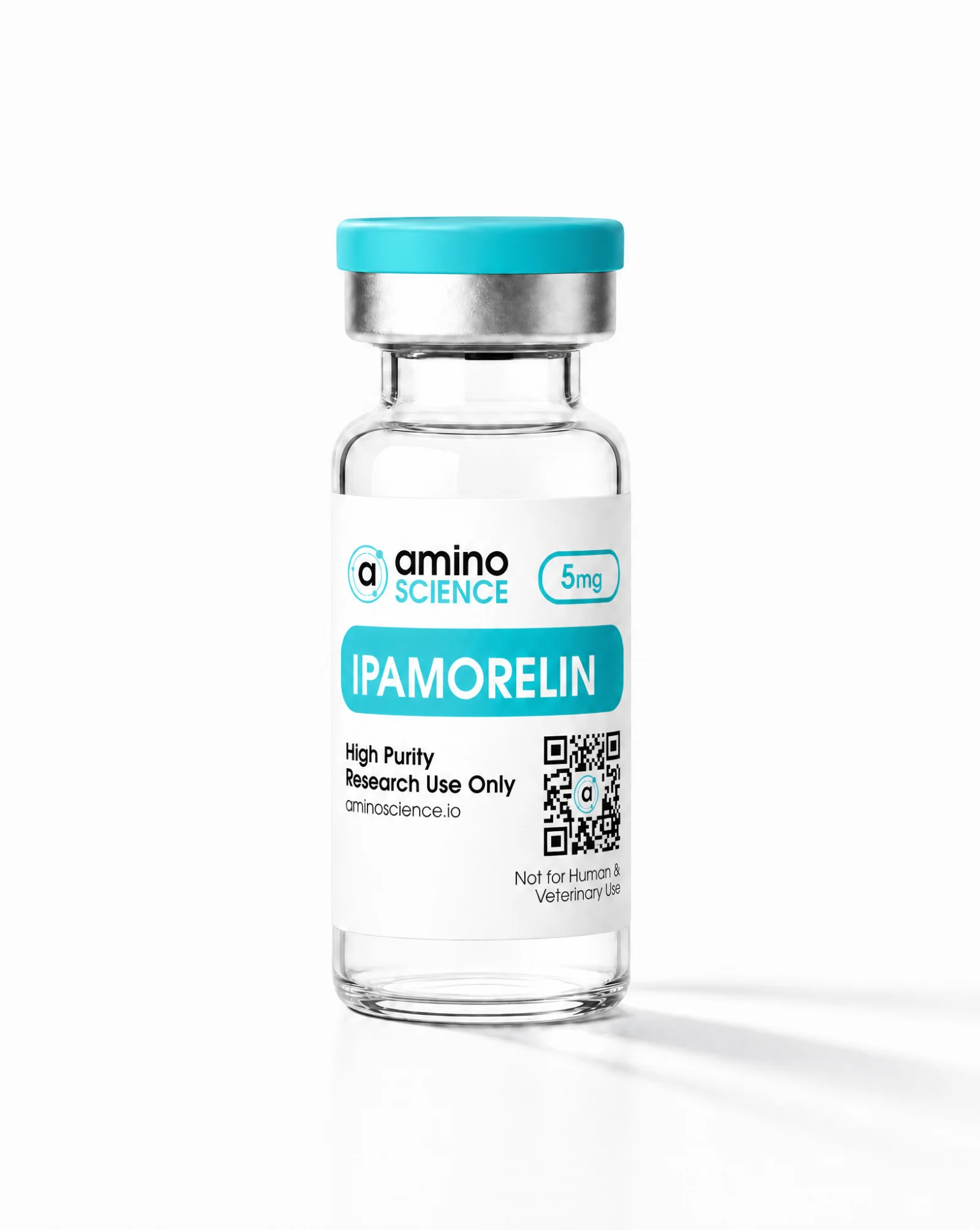
Ipamorelin is a synthetic pentapeptide with the sequence Aib-His-D-2-Nal-D-Phe-Lys-NH2, carrying CAS number 170851-70-4 and the molecular formula C38H49N9O5. In the research literature it is classified as a growth-hormone secretagogue and is supplied as a lyophilized reference material for in-vitro and preclinical laboratory work. At five residues it is among the shortest peptides in regular use as a receptor tool compound.
Structurally it is not a simple linear chain of proteinogenic amino acids. Three of its features are deliberately non-natural: an alpha-aminoisobutyric acid (Aib) cap, a D-configured 2-naphthylalanine, and a D-configured phenylalanine, with the C-terminus amidated. These substitutions are characteristic of secretagogue design, where resistance to exopeptidase degradation and conformational constraint are both objectives.
Research Background: The Secretagogue Family
Growth-hormone secretagogues are compounds that act at the growth-hormone secretagogue receptor, GHSR-1a, better known as the ghrelin receptor. The family spans peptides and small molecules of widely varying size, and a recurring theme in the literature is selectivity. Several early secretagogues engage additional endocrine pathways in preclinical models, producing readouts beyond the one under study, which complicates interpretation.
Ipamorelin recurs in the literature specifically because it is frequently described as one of the more receptor-selective members of the family in cell-based systems. That makes it useful as a comparator compound: when a study needs a secretagogue probe with a comparatively clean profile against which to contrast a less selective agent, ipamorelin is often the one chosen.
Mechanism at the Laboratory Level
GHSR-1a is a G-protein-coupled receptor. In cell-based assays, agonist engagement is measured through standard GPCR readouts in transfected cell lines or pituitary-derived cells expressing the receptor natively. Investigators use these systems to characterize binding affinity, functional potency, and dose-response behavior under controlled conditions.
Reported experimental lines of inquiry involving ipamorelin include:
- Receptor-binding and functional-activation assays at GHSR-1a in transfected or pituitary-derived cell lines.
- Comparative selectivity studies against other growth-hormone secretagogue peptides in matched in-vitro systems.
- Rodent-model and isolated-tissue preparations examining secretagogue pharmacology and dose-response relationships.
- Stability and identity assays characterizing the pentapeptide behavior in solution, including confirmation of its D-configured residues.
These describe observations in controlled laboratory systems only and do not establish outcomes in humans or animals.
Why It Is Catalogued Alongside GHRH Analogs
Ipamorelin is frequently listed and studied next to GHRH analogs such as CJC-1295 and sermorelin, and the pairing reflects a genuine mechanistic distinction rather than a marketing convention. GHRH analogs act at the GHRH receptor; secretagogues like ipamorelin act at GHSR-1a. These are two separate receptors with separate signaling, and preclinical work examining both in the same system is typically probing whether engaging two distinct pathways produces additive readouts. Researchers comparing published results should be careful not to treat the two classes as interchangeable.
Purity, HPLC, and the Certificate of Analysis
Short peptides are comparatively straightforward to synthesize, but ipamorelin's non-natural residues introduce their own characterization requirements: the D-configured residues must be confirmed, since a D to L epimer has an identical mass and will not be distinguished by mass spectrometry alone. Research-grade material is characterized by reversed-phase HPLC for purity, where chromatographic separation can resolve diastereomers, and by mass spectrometry for identity against the theoretical mass for C38H49N9O5. The COA also reports actual fill weight.
Standard Laboratory Storage and Handling
The lyophilized pentapeptide stored cold, dry, and dark is comparatively stable, and its small size and amidated C-terminus make it less prone to some of the degradation pathways that affect longer sequences. Standard practice applies in solution: introduce solvent slowly down the interior vial wall, swirl rather than shake, divide stock into single-use aliquots to avoid repeated freeze-thaw cycling, and label with concentration, solvent, and reconstitution date.
Because D-configured residues share a mass with their L epimers, HPLC characterization matters alongside mass-spectrometry identity for this peptide. Consult the lot Certificate of Analysis for purity method and actual fill weight. This information describes laboratory procedure only and does not describe or imply any human or veterinary application.
Why Blended Preparations Complicate Characterization
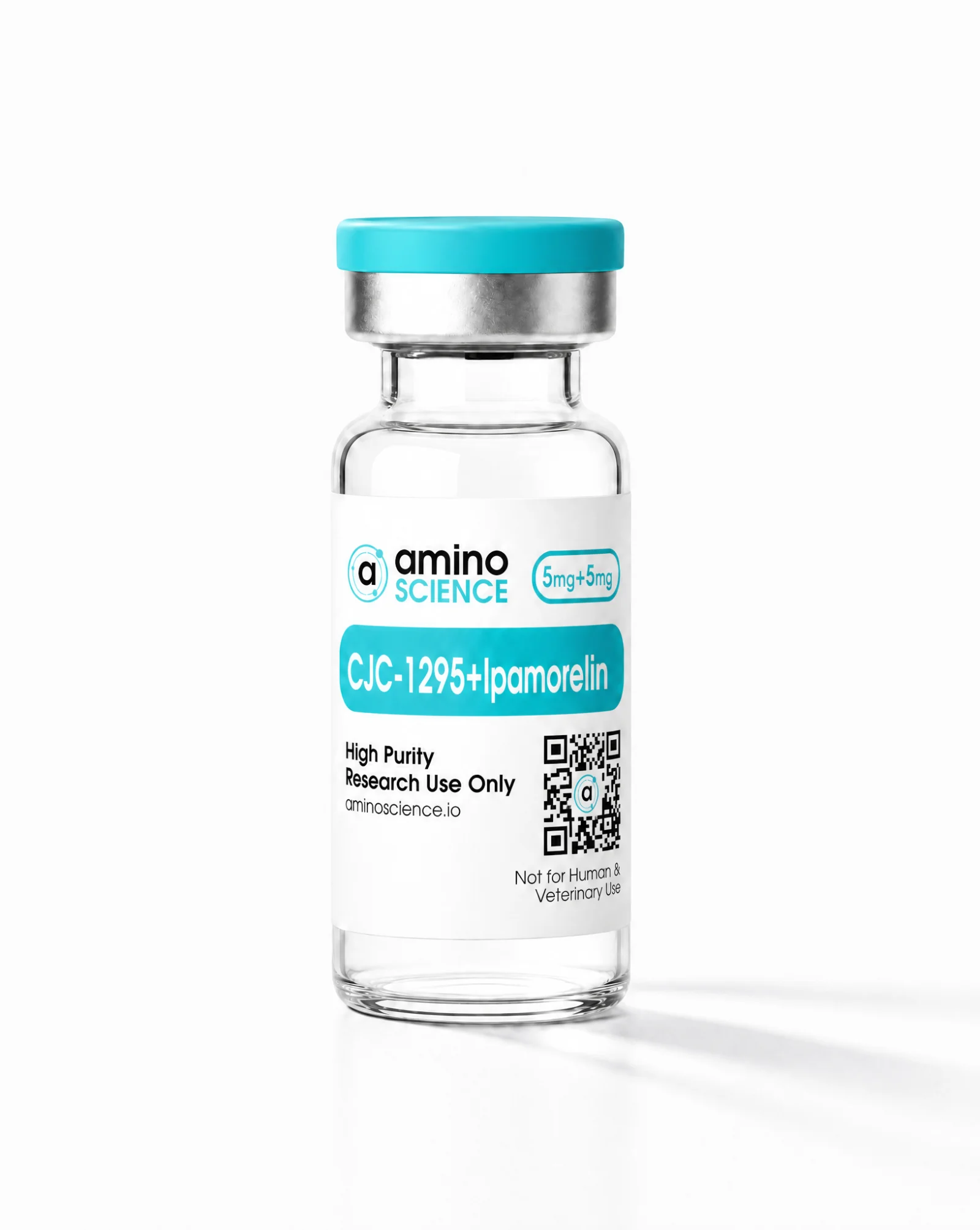
Ipamorelin is frequently supplied in combined preparations alongside a GHRH analog, and these blends raise a characterization question that single-compound vials do not. On a Certificate of Analysis for a blend, the reported purity figure describes the preparation as a whole, while the mass-spectrometry section should confirm each expected component mass separately. A blend COA that reports only a single mass has not established that both peptides are present in the stated proportion.
The ratio question is the substantive one. A preparation nominally containing two peptides at a given ratio can deviate from that ratio through differential synthesis yield, differential loss during lyophilization, or simple blending error, and none of those failures are visible in a single aggregate purity number. For researchers, the practical implication is that experiments comparing a blend against its individual components should be designed with the component masses from the blend COA in hand, rather than assuming the nominal ratio.
Interpreting Selectivity Claims
Ipamorelin's reputation for selectivity is well represented in the literature, but selectivity is a measured property of a specific assay system rather than an intrinsic attribute, and the claim deserves to be read with that in mind. Reported selectivity is typically established by comparing functional activation at GHSR-1a against activation at other endocrine receptor targets in matched cell-based systems. The resulting figure depends on which comparator receptors were tested, which cell background was used, and what concentration range was examined.
This is not a reason to discount the characterization, which is reasonably consistent across published work. It is a reason to check, when selecting a comparator compound for an experiment, that the published selectivity was established against the receptors relevant to the system under study. A compound selective against one panel of receptors has not been shown to be selective against a different panel that was never tested.
What Remains Under Investigation
The receptor target of ipamorelin is well established, but questions remain open regarding the structural basis of its reported selectivity relative to other secretagogues, its comparative behavior across species in preclinical model systems, and how secretagogue and GHRH-receptor pathways interact when engaged together. These are active areas of mechanistic investigation and the published observations remain preliminary.
Frequently asked questions
What receptor does ipamorelin act on?
It acts at the growth-hormone secretagogue receptor GHSR-1a, also known as the ghrelin receptor, a G-protein-coupled receptor. Engagement is characterized in transfected cell lines or pituitary-derived cells using standard GPCR functional readouts.
What is the sequence of ipamorelin?
Aib-His-D-2-Nal-D-Phe-Lys-NH2, a five-residue amidated peptide with molecular formula C38H49N9O5 and CAS number 170851-70-4. Three features are non-natural: the alpha-aminoisobutyric acid cap, the D-configured 2-naphthylalanine, and the D-configured phenylalanine.
Why is ipamorelin described as selective?
It is frequently characterized in cell-based systems as one of the more receptor-selective members of the secretagogue family. Several earlier secretagogues engage additional endocrine pathways in preclinical models, which complicates interpretation, so a comparatively clean probe is useful as a comparator compound.
How does ipamorelin differ from CJC-1295 or sermorelin?
They act at different receptors. GHRH analogs such as CJC-1295 and sermorelin engage the GHRH receptor; ipamorelin engages GHSR-1a. These are separate receptors with separate signaling, and the two classes should not be treated as interchangeable when comparing published work.
Why does HPLC matter specifically for this peptide?
Ipamorelin contains D-configured residues, and a D to L epimer has an identical mass, so mass spectrometry alone cannot detect that error. Reversed-phase HPLC can resolve diastereomers chromatographically, which is why the purity method on the COA matters alongside identity confirmation.
Related research products

Further reading
For research use only. Not for human or veterinary use. This content is educational and summarizes laboratory research; it is not medical advice and makes no health claims.