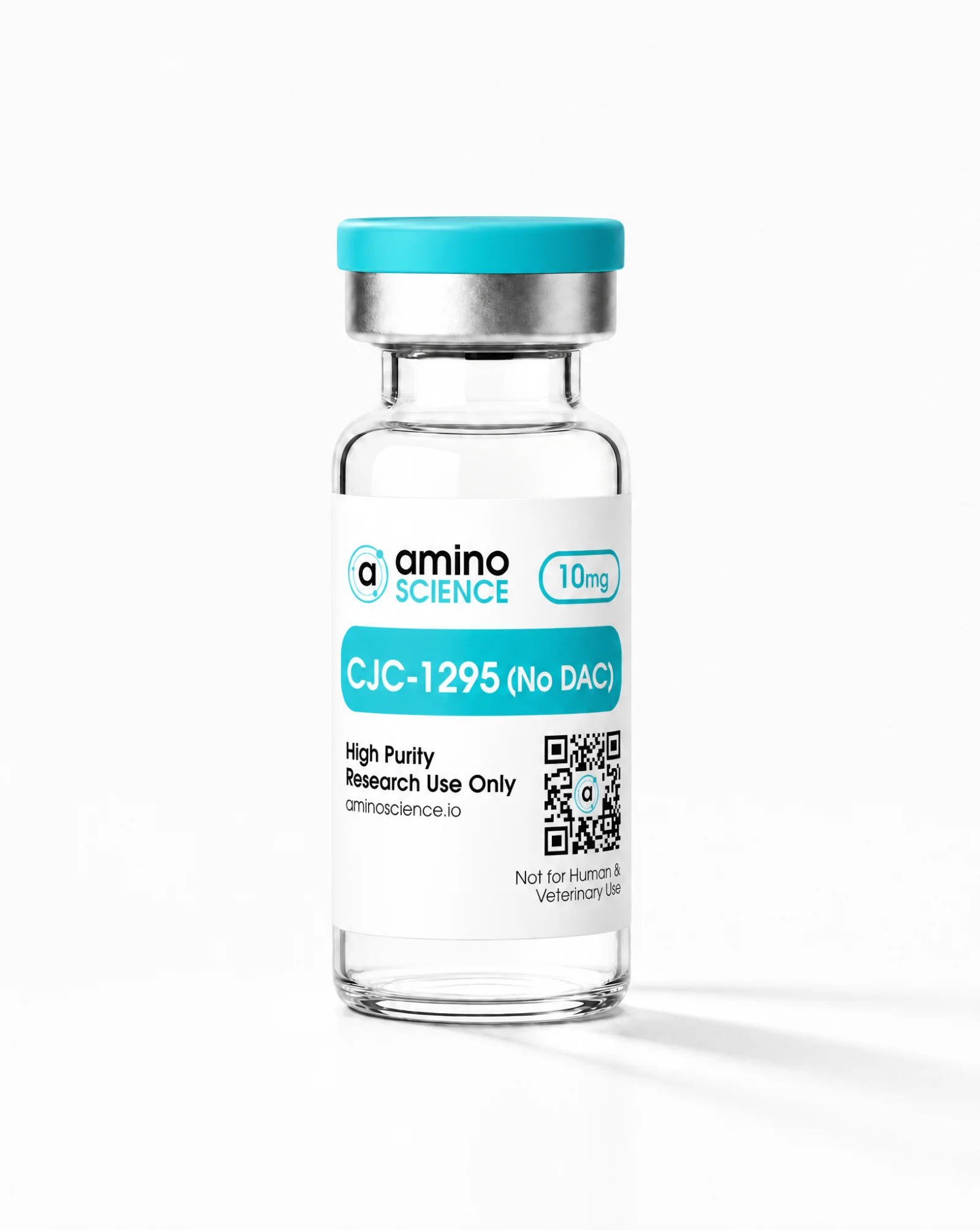
About This Research Blend
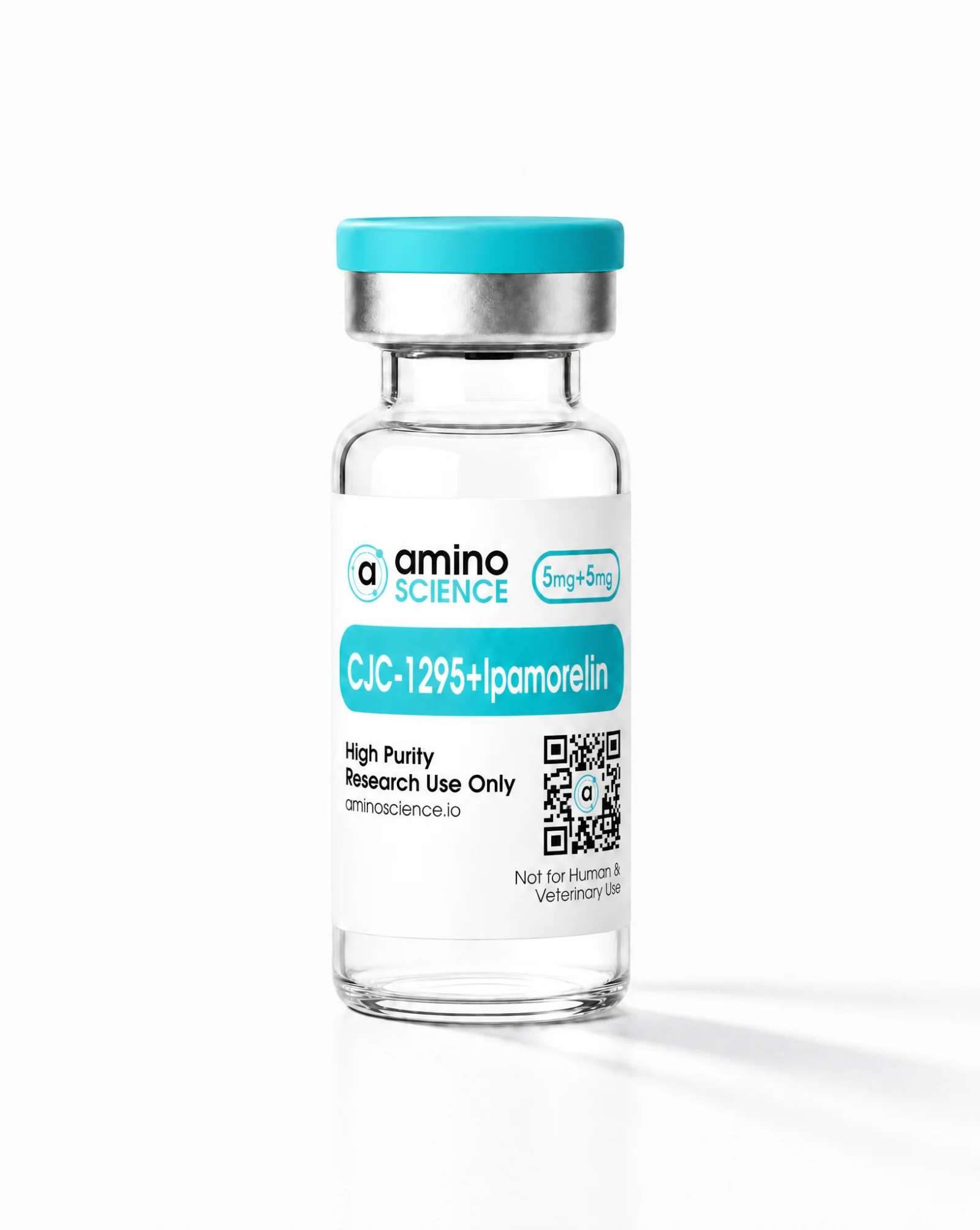
This listing supplies CJC-1295 and Ipamorelin as a single co-formulated research preparation — two distinct synthetic peptides lyophilized together into one vial for in-vitro and preclinical laboratory work. CJC-1295 is a synthetic analog of the growth-hormone-releasing hormone (GHRH) sequence, built on the GRF(1-29) fragment with substituted residues that increase its resistance to enzymatic breakdown in aqueous and plasma-model conditions. Ipamorelin is a short synthetic pentapeptide (Aib-His-D-2-Nal-D-Phe-Lys-NH2) classified in the literature as a growth-hormone secretagogue that acts, in cell-based systems, at the ghrelin/GHS-R1a receptor rather than at the GHRH receptor. Because the two peptides engage separate receptor systems in vitro, they are frequently studied as a pair, and this blend supplies them pre-combined at a fixed ratio for that purpose.
As a combined material, the product is characterized as two independent molecular species that coexist in one lyophilized cake — not a conjugate or a single fused sequence. Each component retains its own molecular formula, monoisotopic mass, and chromatographic behavior. This distinction matters for identity work: an analyst confirming the blend expects to resolve two separate peaks and two separate mass signals, one for each peptide. All descriptions below concern the research substance itself, its documented study history, and standard handling of freeze-dried peptide reference material; they are not statements about outcomes in humans or animals.
What Has Been Studied in Preclinical Models
The individual components of this blend have each been examined in cell-based and rodent-model literature, generally as tools for probing the somatotropic (GH) axis under controlled laboratory conditions. Published in-vitro work on GHRH analogs such as CJC-1295 has focused on receptor binding at the GHRH receptor and on stability profiling — how backbone substitutions slow degradation in serum-model assays. Ipamorelin has appeared in receptor-selectivity studies characterizing GHS-R1a engagement and its reported selectivity relative to other secretagogues in cultured pituitary-cell systems. These reports describe experimental laboratory observations only and do not establish any outcome in humans or animals.
- In-vitro receptor-binding and signaling assays for GHRH-receptor (CJC-1295 component) and GHS-R1a/ghrelin-receptor (Ipamorelin component) pathways.
- Enzymatic and serum-stability profiling used to characterize the modified GRF(1-29) backbone.
- Rodent-model pituitary and somatotropic-axis studies referenced in the growth-hormone-secretagogue literature.
- Combination studies in preclinical systems examining how a GHRH-analog and a GHS-R agonist behave when applied together versus individually.
These references describe experimental laboratory work only. They are not medical claims, are not evidence of safety or efficacy in humans or animals, and should not be interpreted as guidance for any use outside a controlled research environment. Research on these peptides remains preliminary and ongoing, and nothing here constitutes medical advice.
Analytical Characterization
Each blended lot is supplied as a lyophilized powder and characterized before release using orthogonal analytical methods, with results documented on a lot-specific Certificate of Analysis (COA). Because this is a two-peptide preparation, characterization confirms both the identity of each component and their relative proportion, separating purity (how much of each species is the intended peptide) from identity (confirmation that each target is the correct molecule).
- RP-HPLC purity: reversed-phase HPLC resolves the two peptides as distinct peaks, allowing per-component purity to be integrated by peak area and process-related impurities to be distinguished from the target species.
- Mass-spectrometry identity: ESI-MS or MALDI-TOF confirms two observed masses against the theoretical values for the CJC-1295 and Ipamorelin sequences, verifying that both molecules are present and correct.
- Supporting data: appearance, net peptide content, and residual-solvent or water-content checks where applicable, plus the nominal ratio of the two components as loaded.
The COA tied to the lot number received is the definitive analytical record for that specific batch. Because purity, mass, and component ratio can vary slightly between synthesis and fill batches, researchers should reference the accompanying COA rather than generic specifications when documenting experimental inputs — this is especially important for a blend, where the ratio of the two peptides is part of the experimental variable. Retaining the COA alongside experimental records supports reproducibility and traceability.
Laboratory Handling of the Lyophilized Blend
The following describes conventional laboratory handling of lyophilized research peptides and is not instruction for human or animal use. As a freeze-dried peptide preparation, this blend is hygroscopic and sensitive to repeated temperature cycling. Standard laboratory practice is to allow the sealed vial to equilibrate to room temperature before opening to minimize condensation, then reconstitute with an appropriate research-grade solvent under aseptic technique. Because both peptides dissolve into the same working solution, aliquoting reconstituted stock into single-use portions is used to limit freeze-thaw cycles that can degrade either component and shift the effective ratio. Detailed temperature and stability windows for lyophilized, reconstituted, and working solutions appear in the storage table on this page.