CJC-1295 With and Without DAC: A Research Overview
A laboratory reference on the GHRH analog CJC-1295, and the one structural difference between the DAC and No-DAC forms that determines which one a given experiment needs.
November 7, 2026·7 min read
Research Use Only
This article is provided for educational and informational purposes only and describes laboratory and preclinical research. The compound discussed is a research chemical intended strictly for in-vitro and laboratory research use, and is NOT for human or animal consumption, diagnostic, or therapeutic use. Nothing here is medical advice or a claim of safety or efficacy. The research summarized is preliminary and ongoing; observations in cell cultures or animal models do not establish outcomes in humans.
What Is CJC-1295?
CJC-1295 is a synthetic analog of growth-hormone-releasing hormone (GHRH), built on the biologically active N-terminal GHRH(1-29) fragment rather than the full 44-residue hormone. The No-DAC form carries the molecular formula C152H252N44O42 and CAS number 863288-34-0. In the literature this stabilized 1-29 backbone is frequently referred to as modified GRF(1-29), and it is supplied as a lyophilized reference material for in-vitro and preclinical laboratory work.
The substitutions relative to native GHRH(1-29) were introduced to reduce recognition by dipeptidyl peptidase-IV (DPP-IV) and to limit backbone oxidation and cleavage, giving the peptide greater measurable stability than the unmodified fragment in experimental systems. This is the same design logic seen across incretin and secretagogue analogs: identify the dominant degradation pathway and engineer around it.
The One Difference That Matters: DAC
CJC-1295 is catalogued in two forms, and the distinction is substantive rather than a naming footnote. The DAC version bears an additional reactive maleimido-lysine moiety, the Drug Affinity Complex, engineered to bind covalently to albumin in experimental systems. The No-DAC material omits that albumin-binding group entirely.
The consequence is a large difference in measurable persistence. With DAC, the peptide behaves in preclinical assays as a long-circulating albumin conjugate. Without DAC, it behaves as a stabilized short GHRH analog with comparatively brief in-vitro persistence. Researchers select between the two precisely on this basis, and results obtained with one form should not be assumed to transfer to the other.
No DAC (modified GRF 1-29): stabilized 1-29 backbone, no albumin-binding group, short measurable persistence in assay systems. Used where a defined, comparatively brief exposure window is wanted.
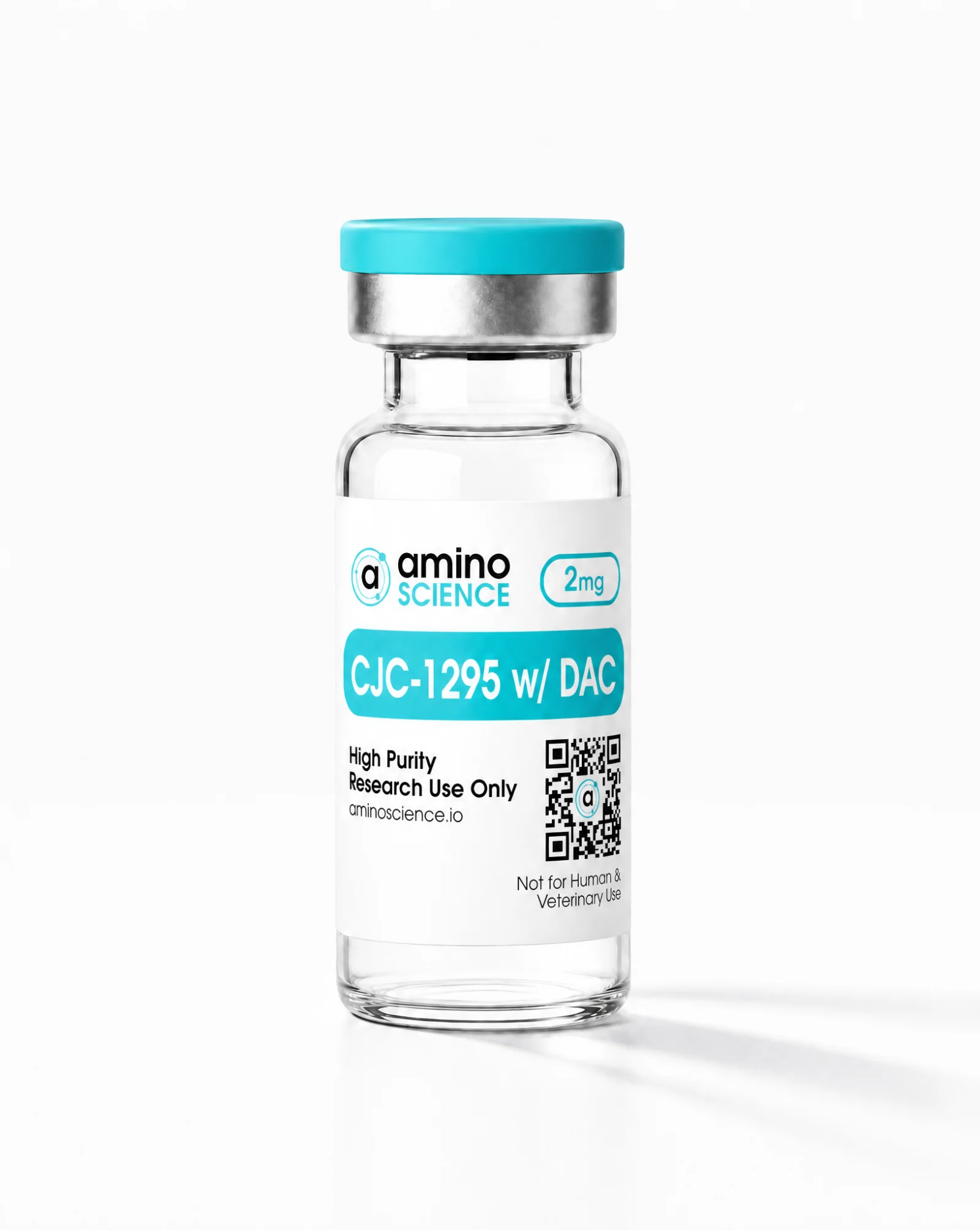
With DAC: adds a maleimido-lysine moiety that conjugates to albumin, markedly extending measurable half-life in preclinical assays. Used where sustained receptor engagement is the subject of study.
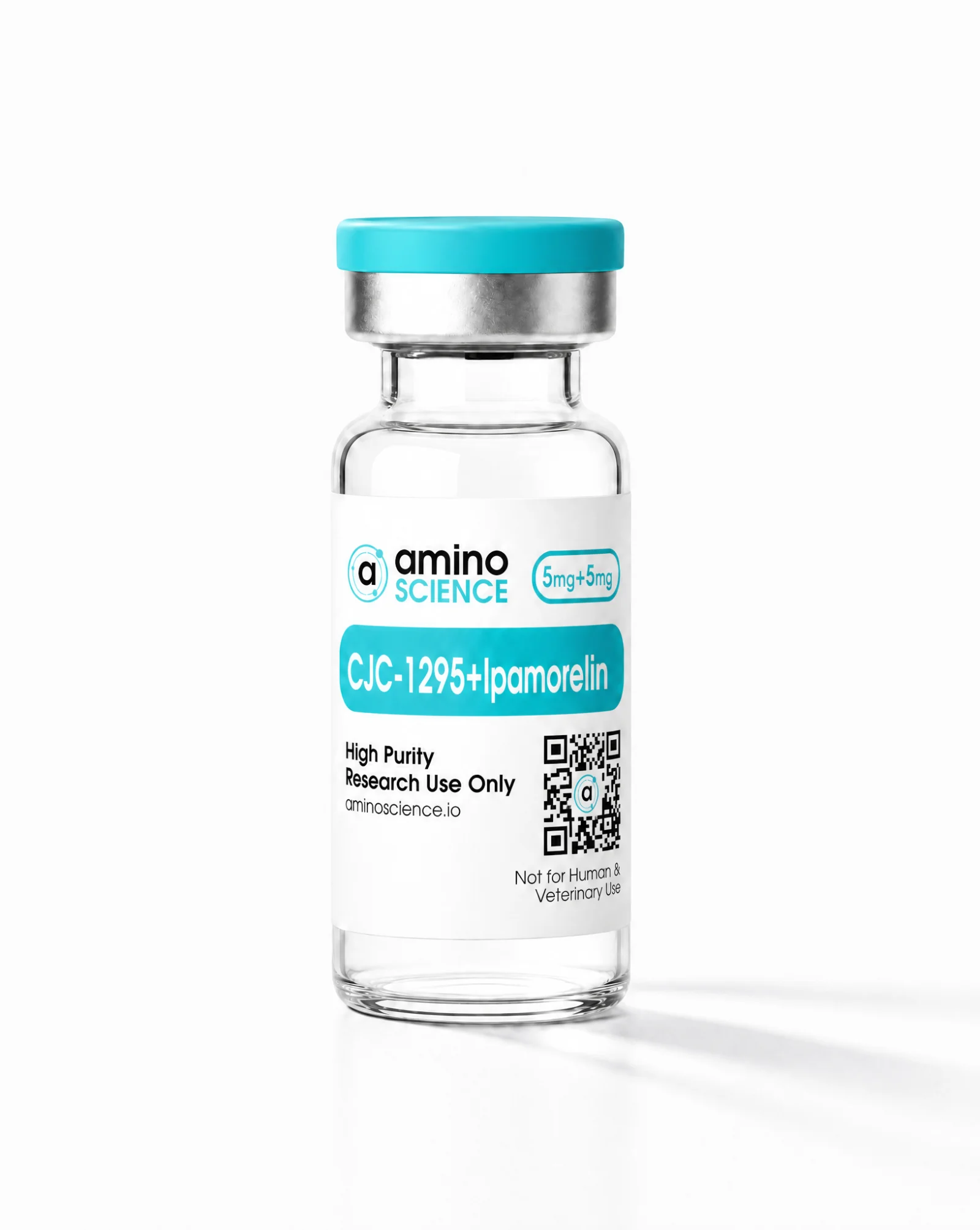
Blends with a secretagogue: pair a GHRH-receptor agonist with a GHSR-1a agonist such as ipamorelin, engaging two distinct receptor pathways in the same preparation.
Mechanism at the Laboratory Level
As a GHRH-receptor agonist tool compound, CJC-1295 appears in the preclinical and in-vitro literature primarily in the context of receptor pharmacology and enzymatic-stability characterization. The GHRH receptor is a class B G-protein-coupled receptor found on pituitary somatotrophs, and cell-based systems measuring downstream cyclic-AMP accumulation are the standard in-vitro signaling endpoint.
A separate and equally common line of work is enzymatic stability: in-vitro comparisons contrasting degradation of the substituted 1-29 backbone against native GHRH(1-29) in the presence of DPP-IV, which isolates the contribution of the specific substitutions. For the DAC form, a third line concerns conjugation chemistry itself, characterizing the maleimide reaction with albumin and the behavior of the resulting conjugate.
GHRH Analogs Versus Secretagogues
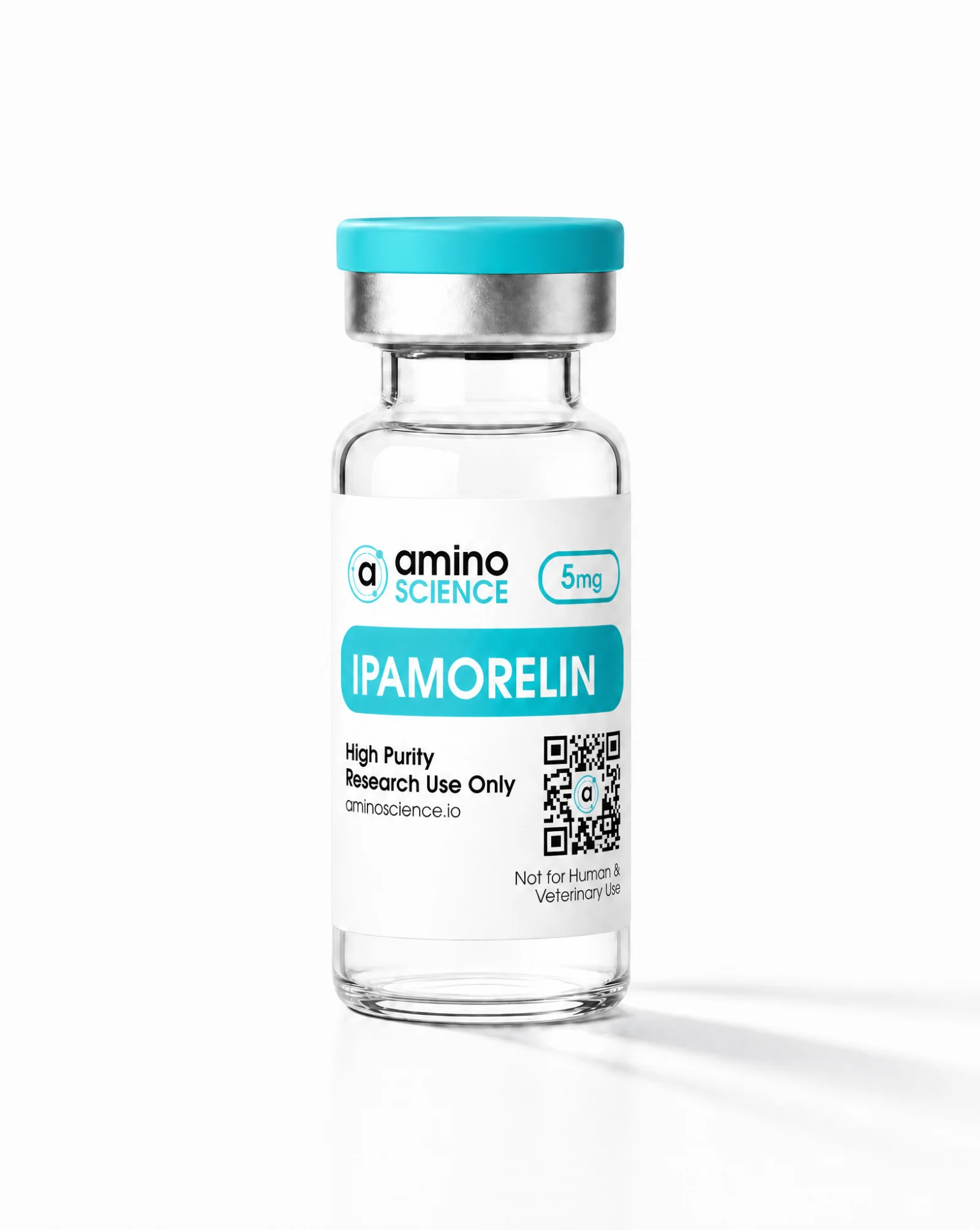
CJC-1295 is routinely catalogued alongside ipamorelin and other growth-hormone secretagogues, and the two are mechanistically distinct. GHRH analogs engage the GHRH receptor; secretagogues engage GHSR-1a, the ghrelin receptor. Preclinical work combining them is typically examining whether two separate receptor pathways produce additive readouts in a shared system. Sermorelin, by comparison, is the unmodified GHRH(1-29) fragment, which makes it the natural stability comparator against which the modified backbone is characterized.
Purity, HPLC, and the Certificate of Analysis
At 29 residues with multiple non-native substitutions, CJC-1295 requires both purity and identity characterization. Research-grade material is characterized by reversed-phase HPLC for purity and mass spectrometry for identity against the theoretical mass for C152H252N44O42. For the DAC form, confirming that the maleimide group is intact and unreacted is an additional consideration, since a hydrolyzed maleimide will not conjugate as intended but may be difficult to detect without targeted analysis. The COA also reports the actual fill weight needed for concentration math.
Standard Laboratory Storage and Handling
Lyophilized material stored cold, dry, and protected from light is comparatively stable. The DAC form warrants extra care because maleimide groups hydrolyze in aqueous solution over time, so solutions are generally prepared fresh and used promptly rather than stored, and buffer pH is a relevant variable. For both forms, standard practice applies: solvent down the interior vial wall, gentle swirling rather than shaking, single-use aliquots to avoid freeze-thaw cycling, and clear labeling of concentration, solvent, and date.
Confirm which form a lot actually is before comparing against published results, since DAC and No-DAC material differ markedly in measurable persistence. For DAC material, note that maleimide hydrolysis in aqueous solution limits how long a prepared stock remains useful. This information describes laboratory procedure only and does not describe or imply any human or veterinary application.
Choosing Between the Two Forms
The decision between DAC and No-DAC material follows from the question being asked rather than from any general superiority of one form. Where the experiment concerns receptor pharmacology itself, binding, potency, signaling bias, or comparison against other GHRH analogs, the No-DAC form is usually the cleaner choice, because the albumin-binding moiety introduces a confounding variable into a measurement that is supposed to be about the receptor.
Where the experiment concerns exposure duration, conjugation chemistry, or the behavior of a long-circulating analog in a preclinical model, the DAC form is the subject of study and the No-DAC form serves as the comparator. Running both arms is common precisely because the pair isolates the contribution of the albumin conjugation from everything else about the molecule.
What should be avoided is treating published results from one form as applicable to the other. The two share a backbone and a CAS lineage, and catalog listings often present them as variants of a single product, which makes the substitution easy to make inadvertently. The measurable persistence difference between them is large enough that an experiment designed around one and executed with the other will not reproduce.
Maleimide Chemistry and Shelf Behavior
The reactive group that gives the DAC form its properties is also its principal stability liability. Maleimides hydrolyze in aqueous solution to the corresponding maleamic acid, which no longer conjugates to thiols. The reaction is pH-dependent and proceeds faster under alkaline conditions, so a DAC-form stock prepared in a neutral-to-slightly-acidic buffer and used promptly retains conjugation capacity better than one held at higher pH or stored for an extended period.
The difficulty is that hydrolysis is not obvious from inspection. The solution looks unchanged, the peptide backbone is intact, and a routine purity assay may not distinguish the hydrolyzed species. This is why the practical guidance for DAC material is procedural rather than analytical: prepare fresh, use promptly, keep the pH controlled, and do not carry stored aqueous stocks across experiments where conjugation efficiency is part of what is being measured.
What Remains Under Investigation
Open questions in this area include the comparative pharmacology of albumin-conjugated versus free GHRH analogs in matched assay systems, the structural basis of the stability gained from each individual substitution in the modified backbone, and how GHRH-receptor and secretagogue-receptor pathways interact when engaged simultaneously. These remain active areas of mechanistic research and published observations are preliminary.
Frequently asked questions
What is the difference between CJC-1295 with DAC and without DAC?
The DAC form carries an additional reactive maleimido-lysine moiety engineered to bind covalently to albumin, which markedly extends measurable half-life in preclinical assays. The No-DAC form omits that group entirely and behaves as a stabilized short GHRH analog with comparatively brief in-vitro persistence. Results from one form should not be assumed to transfer to the other.
What is modified GRF(1-29)?
It is the common literature name for the stabilized CJC-1295 No-DAC backbone: the biologically active N-terminal GHRH(1-29) fragment carrying substitutions that reduce recognition by dipeptidyl peptidase-IV and limit backbone oxidation and cleavage.
How does CJC-1295 differ from ipamorelin?
They act at different receptors. CJC-1295 is a GHRH-receptor agonist; ipamorelin is an agonist at GHSR-1a, the ghrelin receptor. Preclinical work combining them examines whether two distinct receptor pathways produce additive readouts, and the two classes are not interchangeable.
How does CJC-1295 relate to sermorelin?
Sermorelin is the unmodified GHRH(1-29) fragment. CJC-1295 is the same fragment with stabilizing substitutions, which makes sermorelin the natural comparator in enzymatic-stability studies characterizing what those substitutions contribute.
Why do DAC-form solutions need to be prepared fresh?
Maleimide groups hydrolyze in aqueous solution over time. A hydrolyzed maleimide will not conjugate to albumin as intended and can be difficult to detect without targeted analysis, so stocks are generally prepared fresh and used promptly rather than stored.
For research use only. Not for human or veterinary use. This content is educational and summarizes laboratory research; it is not medical advice and makes no health claims.