About This Research Material
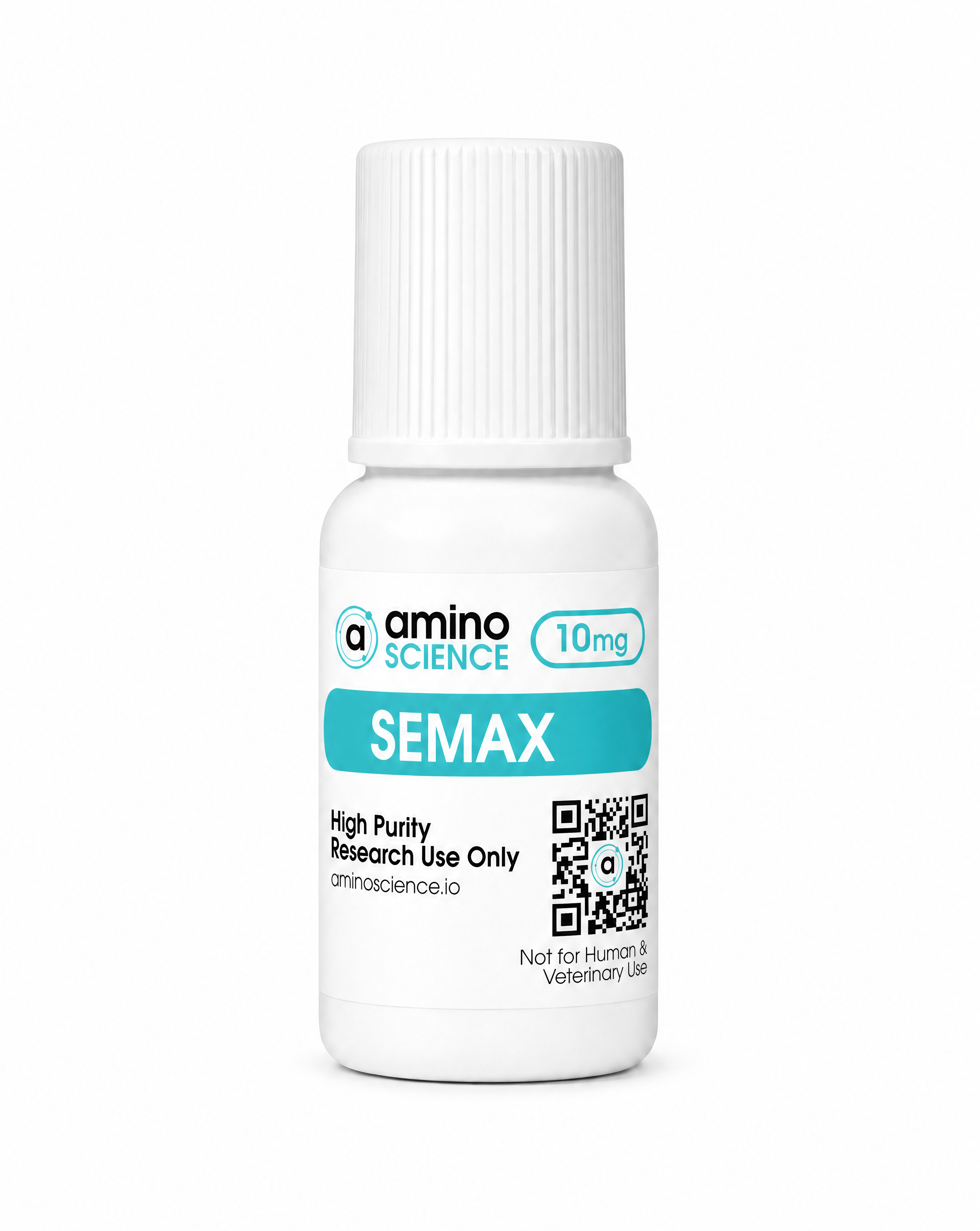
This listing supplies Semax as a pre-dissolved aqueous solution in a metered spray bottle, formatted for in-vitro and preclinical laboratory work rather than as a lyophilized powder. Semax is a synthetic heptapeptide with the sequence Met-Glu-His-Phe-Pro-Gly-Pro. Structurally it is related to the ACTH(4-10) fragment (Met-Glu-His-Phe-Arg-Trp-Gly) region, which was modified and shortened, with a C-terminal Pro-Gly-Pro tripeptide extension appended to the His-Phe-Pro core. That terminal Pro-Gly-Pro is the defining design feature: the proline residues were introduced specifically to slow enzymatic cleavage, giving the molecule notably greater resistance to peptidase degradation than the parent ACTH fragment. Because the peptide is derived from a corticotropin fragment but lacks the residues associated with the hormone's classic endocrine activity, laboratories treat it as a distinct short-chain research peptide rather than as an ACTH analog in the hormonal sense.
Supplying the material as a spray solution rather than a dry powder changes how it is characterized and handled on the bench. The peptide is already in solution at a defined nominal concentration, so the working parameters that matter are solution homogeneity, fill volume, delivered-volume reproducibility per actuation from the pump mechanism, and the stability of the dissolved peptide over the container's in-use life. Everything described below concerns the research substance and its solution format only: its documented study history, its analytical fingerprint, and standard laboratory handling of an aqueous peptide preparation. None of it describes, recommends, or implies any outcome, dosing, or administration in humans or animals.
What Has Been Studied in Preclinical Models
Published investigation of Semax is predominantly rodent-model and in-vitro. A recurring theme in the literature is its use as a probe compound in central-nervous-system research: rodent studies and cell-culture work have examined its association with neurotrophic-factor expression, including brain-derived neurotrophic factor (BDNF) and its receptor TrkB, and transcriptional responses in cultured neuronal and glial systems. Other reported experimental lines include measurements of the peptide's rapid metabolism into shorter fragments (notably the Pro-Gly-Pro terminal fragment, itself studied as a distinct species) and characterization of its distribution in animal models following intranasal delivery in those experimental protocols. These are descriptions of what has been studied in controlled research settings, not statements of health effects.
- Rodent-model studies characterizing neurotrophic-factor and immediate-early-gene expression profiles.
- Cell-culture work examining transcriptional and signaling responses in neuronal and glial lines.
- Metabolism and fragment-formation studies tracking the Pro-Gly-Pro terminal peptide.
- Preclinical pharmacokinetic characterization comparing intranasal versus systemic delivery routes in animal models.
These references describe experimental laboratory work only. They are not medical claims, are not evidence of safety or efficacy in humans or animals, and should not be interpreted as guidance for any use outside a controlled research environment. Research on this peptide remains preliminary and ongoing, and nothing here is medical advice.
Analytical Characterization
Each research lot is characterized before release so that the material on the Certificate of Analysis (COA) matches the sequence, mass, and stated concentration expected for the heptapeptide. Identity and purity are established on the peptide using orthogonal analytical methods, which separates purity (how much of the peptide content is the target sequence) from identity (confirmation that the target is the correct molecule) and from concentration (how much peptide is present per unit volume of solution).
- RP-HPLC purity: quantified by peak-area integration and reported on the COA (commonly ≥ 98%). The chromatogram resolves the main peak from process-related impurities and truncated or oxidized sequences — relevant here because the N-terminal methionine is a site prone to oxidation.
- Mass-spectrometry identity: ESI-MS or MALDI-TOF confirms the observed mass against the theoretical value for Met-Glu-His-Phe-Pro-Gly-Pro, verifying molecular identity.
- Solution parameters: nominal peptide concentration, fill volume, appearance (clear and particulate-free), and pH where applicable, since these define the working solution rather than a reconstitutable powder.
The lot-specific COA is the definitive analytical record for the material received. Because purity, mass confirmation, and measured concentration can vary slightly between synthesis and formulation batches, researchers should reference the COA tied to the lot number in hand rather than generic specifications when documenting experimental inputs. Retaining the COA alongside experimental records supports reproducibility and traceability.
Laboratory Handling of the Solution Format
Because this material ships already in solution rather than as a freeze-dried solid, it does not require reconstitution, but a dissolved short peptide is generally less stable than its lyophilized counterpart. Standard laboratory practice is to keep the sealed container cold and protected from light and heat, to minimize headspace exposure and temperature cycling that can promote methionine oxidation, and to treat the in-use solution as having a limited, empirically confirmed working life. These are material-handling notes for laboratory use only and do not imply any human or animal use; refer to the storage table on this page for temperature and stability windows.