Amino Science Labs sells research peptides exclusively to qualified researchers and laboratories for in vitro and laboratory use. Please confirm before continuing.
By proceeding you affirm the statements above are true. Products are not for human or veterinary use, not for use in diagnostic procedures, and have not been evaluated by the U.S. Food and Drug Administration. Full disclaimer.
An encyclopedic look at tesamorelin, a stabilized GHRH analog studied in laboratory and preclinical models of the growth hormone axis.
June 13, 2026·7 min read
What Is Tesamorelin?
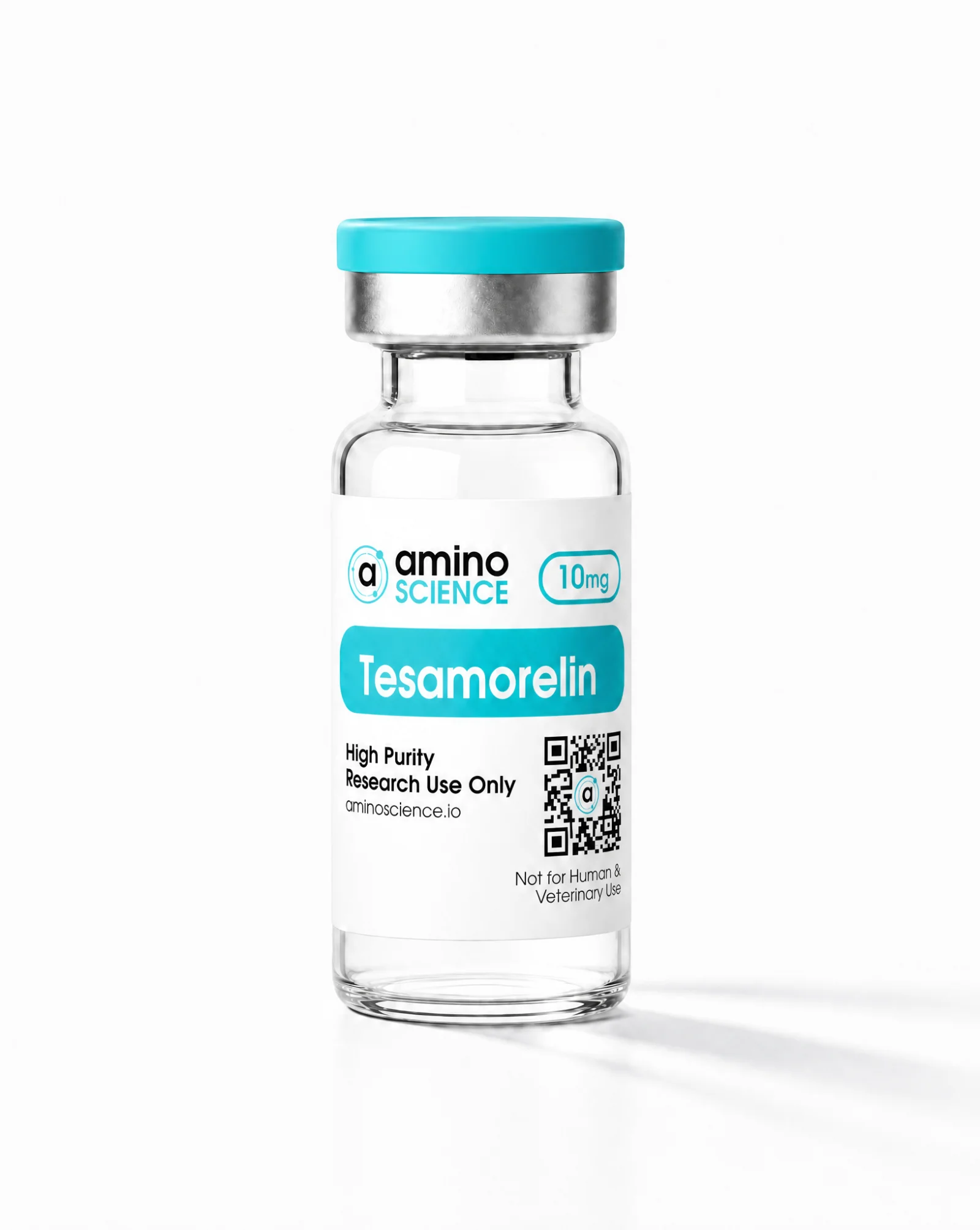
Tesamorelin is a synthetic 44-amino-acid peptide that functions as a stabilized analog of human growth hormone-releasing hormone (GHRH). It has become a frequently referenced compound in laboratory studies of the somatotropic (GH/IGF-1) axis and metabolic signaling. Structurally, tesamorelin reproduces the full 44-residue sequence of native human GHRH(1-44) and adds a chemical modification at the N-terminus. It is cataloged under CAS number 218949-48-5, with a molecular formula of C221H366N72O67S and an approximate molecular weight of 5135.85 g/mol. The peptide terminates in a C-terminal carboxamide, a feature commonly noted in its analytical characterization.
The defining structural element of tesamorelin is a trans-3-hexenoic acid (a C6 side chain) anchored to the amino-terminal tyrosine residue. This modification is the subject of considerable interest in peptide chemistry because it is reported to confer meaningfully greater metabolic stability than native GHRH while preserving receptor-binding characteristics. Because of these properties, tesamorelin is widely used as a reference material for researchers investigating GHRH-receptor pharmacology in controlled, in-vitro and preclinical settings.
Research Background
Native GHRH is a hypothalamic peptide that has been studied for decades as a key upstream regulator of pituitary growth hormone secretion. A central limitation observed in early research was its extremely short circulating half-life, driven largely by rapid enzymatic cleavage. Tesamorelin emerged from efforts to engineer a GHRH-like molecule with improved stability for experimental use. In the published literature, it is frequently described as a GHRH analog or growth hormone-releasing factor (GRF) analog.
Much of the scientific literature surrounding tesamorelin centers on the biology of the GH/IGF-1 axis and on adipose-tissue signaling in preclinical models. Researchers investigating visceral adipose tissue biology, lipid metabolism, and hepatic IGF-1 production have used GHRH-analog tools such as tesamorelin to probe how pulsatile growth hormone signaling is generated and regulated in model systems. It is important to frame all of this as ongoing, preliminary scientific investigation: findings reported in one experimental system do not establish outcomes in others, and the body of research continues to evolve.
Mechanism at a Laboratory Level
At the receptor level, tesamorelin is characterized in the literature as an agonist of the growth hormone-releasing hormone receptor (GHRH-R), a G-protein-coupled receptor expressed on somatotroph cells of the anterior pituitary. In experimental models, engagement of the GHRH-R is associated with downstream signaling that stimulates the synthesis and release of growth hormone in a pulsatile pattern that resembles native GHRH-driven secretion rather than a sustained, non-physiological release.
Growth hormone released in these models acts on multiple tissues, including hepatocytes, where it is associated with production of insulin-like growth factor-1 (IGF-1). This GHRH-R to GH to IGF-1 cascade is the framework most often used to describe tesamorelin's activity in research contexts, and it underpins its use as a tool compound for studying the somatotropic axis.
The Stabilizing Modification
The trans-3-hexenoic acid group at the N-terminus is reported to block the cleavage site targeted by dipeptidyl peptidase-IV (DPP-IV), the enzyme largely responsible for the rapid degradation of native GHRH. By hindering DPP-IV cleavage, this modification is described as extending the peptide's stability relative to unmodified GHRH while retaining binding affinity for the GHRH receptor. The C-terminal amidation is likewise thought to contribute to resistance against serum peptidase activity. Together, these features are the primary reason tesamorelin is studied as a stable experimental analog in laboratory work.
What Has Been Studied (Preclinical / In-Vitro)
In preclinical and in-vitro research, tesamorelin has been examined primarily as a probe of GHRH-receptor activation and its downstream effects on the GH/IGF-1 axis. Reported areas of investigation include the following, all in laboratory or model-system contexts:
GHRH-receptor binding and agonist signaling in pituitary-derived and receptor-expressing cell systems.
Patterns of growth hormone release and the associated hepatic IGF-1 response in animal models.
Adipose-tissue biology, including the differential responsiveness of visceral versus subcutaneous adipose compartments to growth hormone signaling, a topic often noted because visceral adipose tissue is described as having relatively higher growth hormone-receptor density.
Metabolic-signaling endpoints such as lipid handling and glucose metabolism as studied within model systems referenced in the scientific literature.
These research directions are areas of active scientific inquiry. Results are context-dependent, sometimes conflicting across model systems, and should be interpreted as part of an evolving evidence base rather than as settled conclusions. Nothing here should be read as a claim about outcomes in humans or animals, and this article is not medical advice.
Purity, HPLC, and Certificate of Analysis
Because peptide research depends heavily on material identity and consistency, analytical characterization is central to any tesamorelin used as a reference standard. Reputable research-grade material is typically accompanied by a Certificate of Analysis (COA) that documents the batch-specific results of quality-control testing.
High-performance liquid chromatography (HPLC) is the standard method used to assess chromatographic purity; research-grade tesamorelin is commonly specified at high purity levels, frequently reported as 98% or higher by HPLC.
Mass spectrometry (MS) is used to confirm molecular identity by verifying the observed mass against the expected monoisotopic and average molecular weights.
A COA may also report peptide content, water content, and residual-solvent or acetate data depending on the supplier's testing protocol.
When evaluating any lot, researchers are encouraged to review the accompanying COA and confirm that the reported identity and purity align with the intended experimental application before use.
Standard Laboratory Handling and Storage
Tesamorelin is generally supplied as a lyophilized (freeze-dried) powder. The following reflects standard laboratory handling practice for lyophilized peptide research material and is not guidance for any personal, human, or animal use.
Store the lyophilized material desiccated and protected from light. Long-term storage is commonly specified at -20 degrees C or colder.
Prior to reconstitution, sealed vials are commonly allowed to equilibrate to room temperature to limit condensation on the peptide.
For reconstitution in the laboratory, a suitable sterile solvent such as bacteriostatic or sterile water is typically introduced gently against the vial wall rather than directly onto the lyophilized cake; the material is dissolved by slow swirling rather than vigorous agitation.
Repeated freeze-thaw cycles are typically minimized. Preparing single-use aliquots of reconstituted stock is a common laboratory practice to preserve integrity across an experimental timeline.
Reconstituted peptide in solution is generally stored refrigerated and used within a limited window consistent with the laboratory's stability data.
Adhering to consistent storage and handling protocols helps preserve analytical integrity and supports reproducibility across experiments.
Research Use Only
Tesamorelin sold and described here is intended strictly for in-vitro laboratory research and preclinical scientific investigation. It is NOT a drug, dietary supplement, or medical product, and is NOT for human or animal consumption, diagnosis, treatment, or any therapeutic use. Nothing in this article constitutes medical advice or a health claim. All information is educational and reflects preliminary, ongoing research whose conclusions remain under study. Handling should be performed only by qualified individuals in an appropriately equipped laboratory in accordance with all applicable laws and institutional guidelines.
Frequently asked questions
What is tesamorelin in research terms?
Tesamorelin is a synthetic 44-amino-acid analog of human growth hormone-releasing hormone (GHRH). It carries a trans-3-hexenoic acid modification at its N-terminus and is used in laboratory settings as a stabilized reference tool for studying GHRH-receptor pharmacology and the GH/IGF-1 axis. It is intended for in-vitro and preclinical research only.
How is tesamorelin described as working at a laboratory level?
In experimental models, tesamorelin is characterized as an agonist of the growth hormone-releasing hormone receptor (GHRH-R) on pituitary somatotroph cells. Receptor engagement is associated with pulsatile growth hormone release, which in turn is linked to hepatic production of IGF-1. This GHRH-R to GH to IGF-1 cascade is the standard framework used to describe its research activity.
Why is the trans-3-hexenoic acid modification significant?
The N-terminal trans-3-hexenoic acid group is reported to block the dipeptidyl peptidase-IV (DPP-IV) cleavage site that rapidly degrades native GHRH. This is described as extending the peptide's stability while preserving GHRH-receptor binding, which is why tesamorelin is studied as a stable analog in laboratory experiments.
What analytical documentation should accompany research-grade tesamorelin?
Research-grade material is typically supplied with a Certificate of Analysis (COA) reporting HPLC purity (commonly specified at 98% or higher) and mass spectrometry confirmation of molecular identity against the expected molecular weight of approximately 5135.85 g/mol. Reviewing the batch-specific COA before use is standard practice.
How is lyophilized tesamorelin stored in the laboratory?
Lyophilized tesamorelin is generally kept desiccated, protected from light, and stored at -20 degrees C or colder for the long term. Repeated freeze-thaw cycles are minimized, and reconstituted solution is typically aliquoted and refrigerated. This reflects standard handling of lyophilized research material, not personal-use instructions.
For research use only. Not for human or veterinary use. This content is educational and summarizes laboratory research; it is not medical advice and makes no health claims.