A laboratory reference on the 43-residue beta-thymosin peptide: how actin sequestration works at the bench, what has been studied preclinically, and how the material is characterized.
November 7, 2026·7 min read
Research Use Only
This article is provided for educational and informational purposes only and describes laboratory and preclinical research. The compound discussed is a research chemical intended strictly for in-vitro and laboratory research use, and is NOT for human or animal consumption, diagnostic, or therapeutic use. Nothing here is medical advice or a claim of safety or efficacy. The research summarized is preliminary and ongoing; observations in cell cultures or animal models do not establish outcomes in humans.
What Is TB-500?
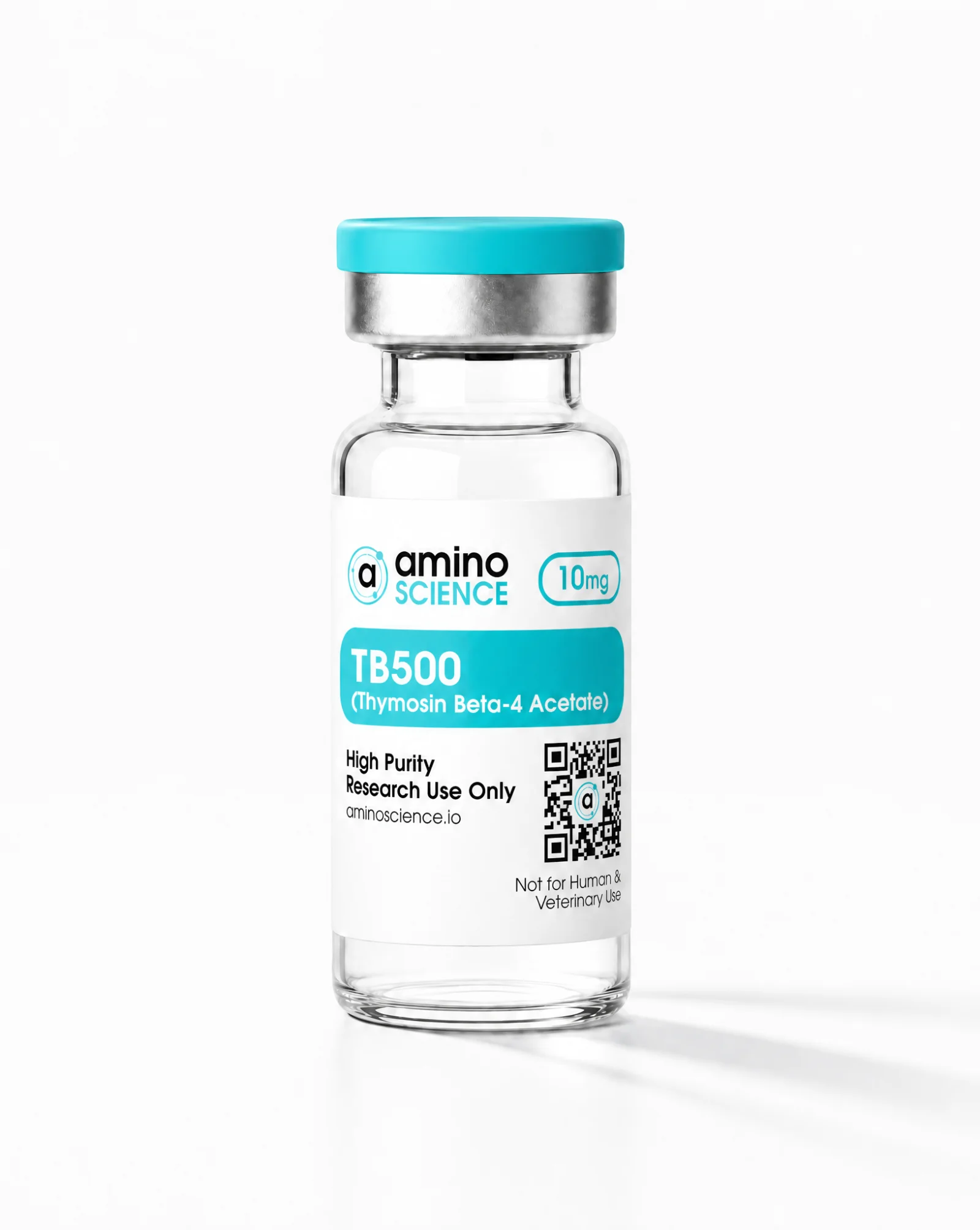
TB-500 is the laboratory shorthand for synthetic Thymosin Beta-4 preparations, supplied as the acetate salt of a 43-residue, water-soluble peptide in the beta-thymosin family. It carries CAS number 77591-33-4 and the molecular formula C212H350N56O78S, the single sulfur reflecting one methionine within an otherwise acidic, largely unstructured chain. Thymosin Beta-4 is frequently abbreviated Tbeta4 in the literature and is among the most abundant and best-studied members of its family.
A naming distinction is worth establishing up front, because it causes recurring confusion in supplier catalogs and search results. The designation TB-500 has historically been applied both to full-length synthetic Thymosin Beta-4 and to shorter fragments containing the actin-binding region. Researchers comparing results across studies should confirm from the Certificate of Analysis which material a given lot actually is, since fragment and full-length preparations do not behave identically in binding assays.
Research Background
Beta-thymosins were first characterized as abundant intracellular peptides and were initially studied in the context of thymic tissue, from which the family name derives. Attention shifted decisively once the actin-binding function was established, and Thymosin Beta-4 is now primarily encountered in the literature as a cytoskeletal tool compound rather than an immunological one. Its small size, high solubility, and lack of stable secondary structure in isolation make it a tractable reagent for cell-free biochemistry.
Mechanism at the Laboratory Level
The defining structural feature of the peptide is a short conserved segment commonly written as the LKKTET-type motif, which mediates interaction with monomeric G-actin. In cell-free systems, Thymosin Beta-4 binds G-actin in a one-to-one complex and sequesters it, maintaining a buffered pool of unpolymerized monomer. Because actin polymerization into F-actin filaments depends on available monomer concentration, this sequestration indirectly regulates the rate and extent of filament assembly.
That mechanism is what makes the peptide useful on the bench. Investigators studying cytoskeletal dynamics use it to manipulate the free G-actin pool in a controlled way, then observe downstream effects on filament turnover, cell shape, and motility. It is one of several sequestering proteins used for this purpose, and comparative studies frequently contrast it with profilin and other actin-binding proteins that act through different mechanisms.
What Has Been Studied Preclinically
Published work on Thymosin Beta-4 is predominantly in-vitro and rodent-model in nature, and is best understood as mechanistic and hypothesis-generating rather than settled. Reported experimental lines include:
Actin-sequestration biochemistry in cell-free and cell-culture assays, characterizing how the peptide binds and buffers pools of monomeric G-actin.
Cell-migration and scratch-wound assays examining endothelial and fibroblast migration and closure dynamics in cultured monolayers.
Angiogenesis-associated endpoints in preclinical model systems used to probe vascular and tissue-remodeling signaling pathways.
Comparative fragment studies contrasting the full-length peptide with shorter actin-binding fragments to map which residues drive the observed activity.
Analytical and stability work characterizing the behavior of a long, highly acidic, methionine-containing sequence in solution.
None of these observations establish outcomes in humans or animals. They describe behavior in controlled laboratory systems, and the surrounding body of work remains preliminary and ongoing.
Why It Is Often Studied Alongside BPC-157
Thymosin Beta-4 and BPC-157 appear together in supplier catalogs and in some preclinical literature because both are short synthetic sequences that have been investigated in tissue-remodeling model systems. Mechanistically they are unrelated: BPC-157 is a 15-amino-acid sequence with a distinct and less well-defined proposed mechanism, while Thymosin Beta-4 acts through a specific and well-characterized actin-binding interaction. Researchers using combined preparations are typically probing whether distinct pathways produce additive readouts in a given assay, not assuming a shared mechanism.
Purity, HPLC, and the Certificate of Analysis
At 43 residues, Thymosin Beta-4 is long enough that synthesis-related impurities, particularly deletion sequences, are a meaningful consideration. Research-grade material is characterized by reversed-phase HPLC for purity and by mass spectrometry for identity against the theoretical mass for C212H350N56O78S. The presence of a methionine residue also makes oxidation a relevant degradation pathway, which is why identity confirmation matters alongside the purity percentage. The COA reports both, plus the actual fill weight needed for concentration math.
Standard Laboratory Storage and Handling
The lyophilized peptide is highly water-soluble and reconstitutes readily, typically in sterile or bacteriostatic water. Stored cold, dry, and dark, the dry material is comparatively stable. In solution the peptide is more labile, and the methionine residue introduces susceptibility to oxidation, so minimizing headspace, avoiding repeated freeze-thaw cycling, and dividing stock into single-use aliquots are standard precautions.
Confirm from the lot Certificate of Analysis whether the material is full-length Thymosin Beta-4 or a shorter actin-binding fragment before comparing results against published work. This information describes laboratory procedure only and does not describe or imply any human or veterinary application.
Telling Full-Length From Fragment on the COA
Because the TB-500 designation has been applied to both full-length Thymosin Beta-4 and shorter actin-binding fragments, the mass-spectrometry result on the Certificate of Analysis is the practical way to tell which material a vial actually contains. Full-length Thymosin Beta-4 corresponds to the molecular formula C212H350N56O78S, an observed mass in the region of 4.9 kDa. A short fragment spanning only the actin-binding region would come in at a small fraction of that, well under 1 kDa. The two are not ambiguous on a mass spectrum; they are simply different molecules sold under a shared name.
This matters for interpretation rather than quality. A fragment preparation is not defective material, but binding affinities, stoichiometry, and comparability to published full-length work all change. A researcher reproducing an assay from a paper that used full-length peptide needs full-length peptide, and the only reliable confirmation is the observed mass on the lot COA.
Concentration Math and Solution Handling
Thymosin Beta-4 is highly water-soluble, which makes reconstitution straightforward, but the same acidic character that drives solubility also makes the peptide sensitive to buffer pH during extended incubations. As with any research peptide, the solvent volume should be computed from the actual fill weight on the COA rather than the labeled amount. For a vial with a COA fill weight of 10.35 mg and a target stock of 5 mg/mL, that is 2.07 mL of solvent.
The methionine residue is the handling detail most specific to this peptide. Oxidation of methionine adds sixteen mass units and is detectable by mass spectrometry, which is one reason identity confirmation is worth reading alongside the purity percentage on an older lot. Practical mitigations are the standard ones: minimize headspace in stored aliquots, avoid repeated freeze-thaw cycling by dividing stock into single-use volumes, and keep solutions cold and protected from light.
What Remains Under Investigation
The actin-sequestering biochemistry of Thymosin Beta-4 is well established, but much of the downstream biology attributed to the peptide in model systems is not fully resolved. Open questions include which observed effects follow directly from actin buffering versus separate interactions, how full-length peptide and fragments differ functionally, and how the extracellular behavior reported in some models relates to a peptide whose primary characterized role is intracellular. These remain active areas of mechanistic research.
Frequently asked questions
Is TB-500 the same thing as Thymosin Beta-4?
TB-500 is laboratory shorthand historically applied both to full-length synthetic Thymosin Beta-4 and to shorter fragments containing the actin-binding region. Because the two do not behave identically in binding assays, researchers should confirm from the Certificate of Analysis which material a given lot actually is.
What is the LKKTET motif?
It is the short conserved segment within beta-thymosins that mediates binding to monomeric G-actin. This motif is the structural basis for the peptide's actin-sequestering function and is the region most studied in comparative fragment work.
How does actin sequestration work mechanistically?
Thymosin Beta-4 binds G-actin in a one-to-one complex, maintaining a buffered pool of unpolymerized monomer. Because polymerization into F-actin filaments depends on available monomer concentration, this sequestration indirectly regulates filament assembly rate and extent in cell-free and cell-culture systems.
Why is oxidation a specific concern for this peptide?
The sequence contains a single methionine residue, reflected in the sulfur atom of its molecular formula C212H350N56O78S. Methionine is susceptible to oxidation, so mass-spectrometry identity confirmation on the COA matters alongside the HPLC purity figure, and solution handling should minimize headspace and freeze-thaw cycling.
Why do BPC-157 and TB-500 appear together so often?
Both are short synthetic sequences investigated in tissue-remodeling model systems, which is why they are catalogued and sometimes studied together. Their mechanisms are unrelated: Thymosin Beta-4 acts through a well-characterized actin-binding interaction, while BPC-157's proposed mechanism is distinct and less well defined.
For research use only. Not for human or veterinary use. This content is educational and summarizes laboratory research; it is not medical advice and makes no health claims.