Amino Science Labs sells research peptides exclusively to qualified researchers and laboratories for in vitro and laboratory use. Please confirm before continuing.
By proceeding you affirm the statements above are true. Products are not for human or veterinary use, not for use in diagnostic procedures, and have not been evaluated by the U.S. Food and Drug Administration. Full disclaimer.
How to Reconstitute Research Peptides: A Step-by-Step Guide
A laboratory reference on dissolving lyophilized research peptides for in-vitro study, from solvent selection to storage.
June 25, 2026·7 min read
Research use only. The compounds and procedures described here are intended strictly for in-vitro and preclinical laboratory research. They are not for human or animal use, diagnosis, treatment, or consumption. This article is educational and describes what has been studied in research settings; it is not medical advice, and the research summarized is preliminary and ongoing.
What Reconstitution Means in a Research Context
Most research peptides are supplied as a lyophilized (freeze-dried) powder or cake sealed in a glass vial. Lyophilization removes water from the material under vacuum, producing a dry solid that is far more chemically stable than a solution and better suited to shipping and long-term storage. Before a peptide can be used in an in-vitro assay or other laboratory experiment, that solid must be returned to a liquid state at a known concentration. This process is called reconstitution: a defined volume of solvent is added to the vial so the lyophilized material dissolves into a solution of predictable molarity. Reconstitution is a standard bench procedure for handling lyophilized research reagents; the objective is an accurately concentrated, homogeneous, and uncontaminated stock solution for controlled experimental work.
This guide describes general laboratory handling of lyophilized research material. It is written for a research audience working with compounds intended strictly for in-vitro and preclinical investigation, and none of the procedures below describe or imply human or animal use.
Research Background: Why Technique Matters
Peptides are chains of amino acids held in specific conformations by comparatively fragile bonds and non-covalent interactions. In research settings, investigators have long observed that the same lyophilized sequence can behave inconsistently across experiments when reconstitution and storage are not controlled. The dominant variables reported in the literature are solvent choice, mechanical stress during dissolution, temperature, exposure to light and oxygen, and the number of freeze-thaw cycles a solution undergoes. Because assay reproducibility depends on delivering a known quantity of intact peptide to each experimental condition, careful reconstitution is treated as a foundational step rather than an afterthought. Standardizing the procedure reduces variability that would otherwise confound downstream measurements.
Mechanism at the Laboratory Level
When solvent contacts a lyophilized cake, water molecules progressively solvate the peptide, breaking the solid-state packing and dispersing individual molecules into solution. Two competing processes matter here. First, gentle solvation allows molecules to separate cleanly and adopt their solution-phase conformation. Second, excessive mechanical force, such as a jet of solvent striking the cake directly, or vigorous shaking, introduces shear and air-liquid interfaces that can promote unfolding and aggregation. Aggregation, in which hydrophobic surfaces of partially unfolded molecules associate, is a frequently cited failure mode because aggregated material may not fully redissolve and can alter effective concentration.
Other degradation pathways documented in stability studies include oxidation of susceptible residues (methionine, tryptophan, cysteine), deamidation of asparagine and glutamine, hydrolysis of the peptide backbone, and slow racemization. Temperature, pH, and oxygen exposure all influence the rate of these reactions, which is why solution-phase peptides are handled cold, in the dark, and for limited periods.
Solvent Selection
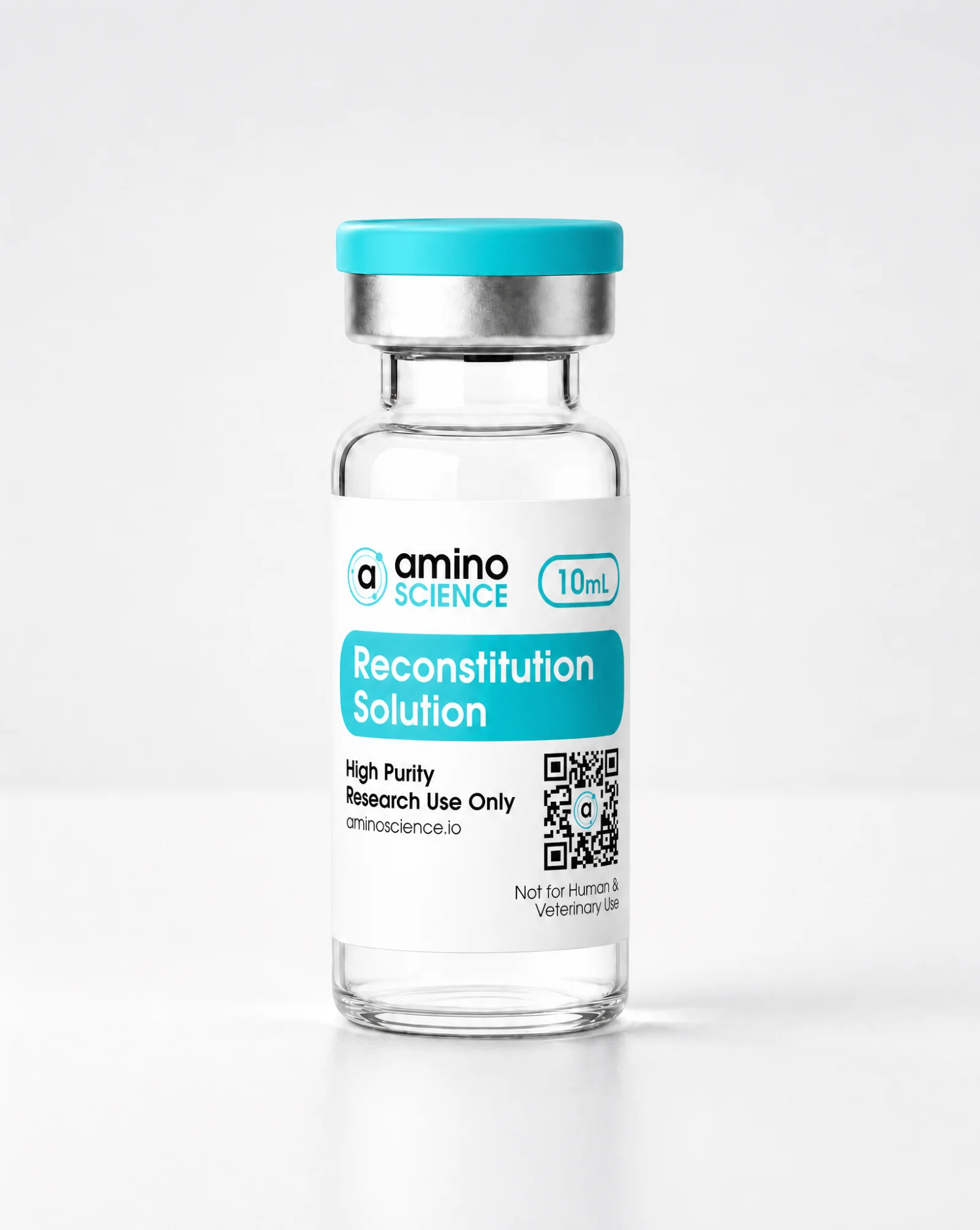
The appropriate solvent depends on the sequence. Many research peptides dissolve readily in sterile or bacteriostatic water. Bacteriostatic water is sterile water containing roughly 0.9 percent benzyl alcohol, a preservative that inhibits microbial growth and therefore supports repeated, sterile withdrawal from a single vial over an extended handling window in the laboratory. More hydrophobic sequences may require a small amount of a co-solvent, such as dilute acetic acid for basic peptides or dilute ammonium bicarbonate for acidic peptides, before dilution into the working buffer. A pre-assembled peptide-reconstitution-kit typically bundles the bacteriostatic solvent, syringes, and alcohol prep materials used to keep the laboratory procedure clean and consistent.
Always consult the sequence-specific solubility guidance and Certificate of Analysis for the exact lot before selecting a solvent. General rules do not override lot-specific data. This information is provided for laboratory reference only.
Step-by-Step Laboratory Procedure
Review the Certificate of Analysis (COA) and record the actual fill weight rather than assuming the labeled amount, since concentration math depends on the true mass in the vial.
Allow the sealed vial to reach room temperature to reduce condensation on the cold cake, and inspect the lyophilate visually.
Calculate the solvent volume needed for the target concentration. For example, adding 2 mL of solvent to a vial containing 10 mg yields a nominal 5 mg/mL stock; adjust using the COA fill weight.
Sanitize the rubber stopper of both the peptide vial and the solvent vial with an alcohol prep pad.
Draw the calculated solvent volume, then introduce it slowly so the stream runs down the interior glass wall of the vial rather than striking the cake directly.
Let the vial rest undisturbed. Swirl gently if needed; do not shake or vortex, as agitation introduces shear and foaming.
Once the solution is clear and complete, verify there is no undissolved material, particulate, or cloudiness before use in the assay.
Label the vial with concentration, solvent, and reconstitution date for traceability.
Purity, HPLC, and the Certificate of Analysis
Reconstitution can only preserve the quality already present in the lyophilized material; it cannot improve a low-purity starting reagent. For this reason, research-grade peptides are typically characterized before distribution by reversed-phase High-Performance Liquid Chromatography (HPLC), which resolves the target peptide from truncated sequences and other impurities, and by mass spectrometry (MS), which confirms molecular identity. A COA generally reports the measured HPLC purity (often stated as a percentage), the MS-confirmed mass, and the fill weight. Reviewing these values before reconstitution is standard practice: purity affects the amount of intact peptide actually delivered to an assay, and the fill weight is the input to accurate concentration calculations. Retaining the COA alongside experimental records supports reproducibility and traceability.
Standard Laboratory Storage and Handling
Stability differs markedly between the dry and dissolved states. Lyophilized peptides stored cold, dry, and protected from light are comparatively stable, and many sequences remain suitable for extended periods when held frozen. Once reconstituted, the same peptide becomes considerably more labile, and its usable window in solution is measured in days to weeks rather than months. Solutions are therefore generally held refrigerated at 2 to 8 degrees Celsius for near-term work and shielded from light.
Where longer solution storage is required, a common laboratory strategy is to divide the stock into single-use aliquots and freeze them, so that only the portion needed for an experiment is thawed. This avoids repeated freeze-thaw cycling, which stability studies associate with structural disruption and loss of activity, since ice-crystal formation can physically stress the dissolved peptide. Bacteriostatic solvent supports sterile repeat access to a refrigerated working vial, but it does not extend chemical stability indefinitely. Discard solutions that become cloudy, discolored, or show visible particulate.
What Remains Under Investigation
The reconstitution and storage practices summarized here reflect general laboratory conventions and published stability observations, but optimal conditions are sequence-dependent and remain an active area of investigation. Solubility behavior, degradation kinetics, and freeze-thaw tolerance vary by amino acid composition, and researchers commonly determine empirically the best solvent, concentration, and storage protocol for a given peptide within their own experimental system. Treat the guidance above as a starting framework to be validated for each specific reagent and study design. This material is provided for laboratory research reference only and is not medical advice.
Frequently asked questions
What solvent is typically used to reconstitute research peptides in the laboratory?
Sterile or bacteriostatic water is commonly used for water-soluble sequences. Bacteriostatic water contains a benzyl-alcohol preservative that supports repeated sterile access to a refrigerated working vial. Hydrophobic or charged sequences may require a small amount of an acidic or basic co-solvent before dilution. Solvent choice should follow the sequence-specific solubility guidance and the Certificate of Analysis for the lot.
Why should solvent not be added directly onto the peptide cake?
Directing a stream of solvent onto the lyophilized cake introduces mechanical shear that can promote unfolding and aggregation. Research handling conventions favor letting solvent run slowly down the interior glass wall, then allowing the vial to rest so the material dissolves gently. Shaking and vortexing are generally avoided for the same reason.
How is peptide purity verified, and why does it matter for reconstitution?
Research-grade peptides are typically characterized by reversed-phase HPLC for purity and by mass spectrometry for identity, with results reported on a Certificate of Analysis. Reconstitution preserves but cannot improve starting purity, so reviewing the COA, including the measured purity and the actual fill weight, is standard before dissolving and before calculating concentration.
How does storage stability differ between lyophilized and reconstituted peptides?
Lyophilized peptides stored cold, dry, and dark are comparatively stable over extended periods. Once in solution, peptides become far more labile, with a usable window of days to weeks depending on the sequence and conditions. Solutions are generally refrigerated and protected from light, and aliquoting before freezing is used to avoid repeated freeze-thaw cycles.
Why are repeated freeze-thaw cycles discouraged for reconstituted peptides?
Stability studies associate repeated freeze-thaw cycling with structural disruption, because ice-crystal formation can physically stress the dissolved peptide and encourage misfolding or aggregation. Dividing a stock into single-use aliquots so only the needed portion is thawed is a common laboratory approach to minimize this exposure.
For research use only. Not for human or veterinary use. This content is educational and summarizes laboratory research; it is not medical advice and makes no health claims.