Amino Science Labs sells research peptides exclusively to qualified researchers and laboratories for in vitro and laboratory use. Please confirm before continuing.
By proceeding you affirm the statements above are true. Products are not for human or veterinary use, not for use in diagnostic procedures, and have not been evaluated by the U.S. Food and Drug Administration. Full disclaimer.
A neutral, laboratory-focused look at nicotinamide adenine dinucleotide (NAD+): its structure and redox biochemistry, the sirtuin, PARP, and CD38 enzyme systems that consume it, what has been examined in preclinical models, and how research-grade lyophilized material is characterized and handled.
June 19, 2026·7 min read
Research Use Only
This article is provided for educational and informational purposes only and describes laboratory, in-vitro, and preclinical research. NAD+ as supplied here is a research chemical intended strictly for in-vitro and laboratory research use, and is NOT for human or animal consumption, diagnostic, or therapeutic use. Nothing here is medical advice or a claim of safety or efficacy. The research summarized is preliminary and ongoing; observations in cell cultures, isolated enzymes, or animal models do not establish outcomes in humans. Handling of any research material should follow applicable institutional and regulatory safety requirements.
What Is NAD+?
Nicotinamide adenine dinucleotide (NAD+) is one of the most extensively studied coenzymes in cell biology. Structurally it is a dinucleotide: two nucleotides joined through their phosphate groups by a pyrophosphate bridge. One nucleotide carries an adenine base and the other carries a nicotinamide (niacinamide) moiety, each attached to a ribose sugar. The nicotinamide ring is the chemically active part of the molecule, and it is where the redox chemistry that defines NAD+ takes place. The molecular formula of the free acid is C21H27N7O14P2, corresponding to a molecular weight of roughly 663 g/mol; research material is frequently supplied as the free acid or as the disodium salt (NAD+ disodium), which shifts the reported mass accordingly.
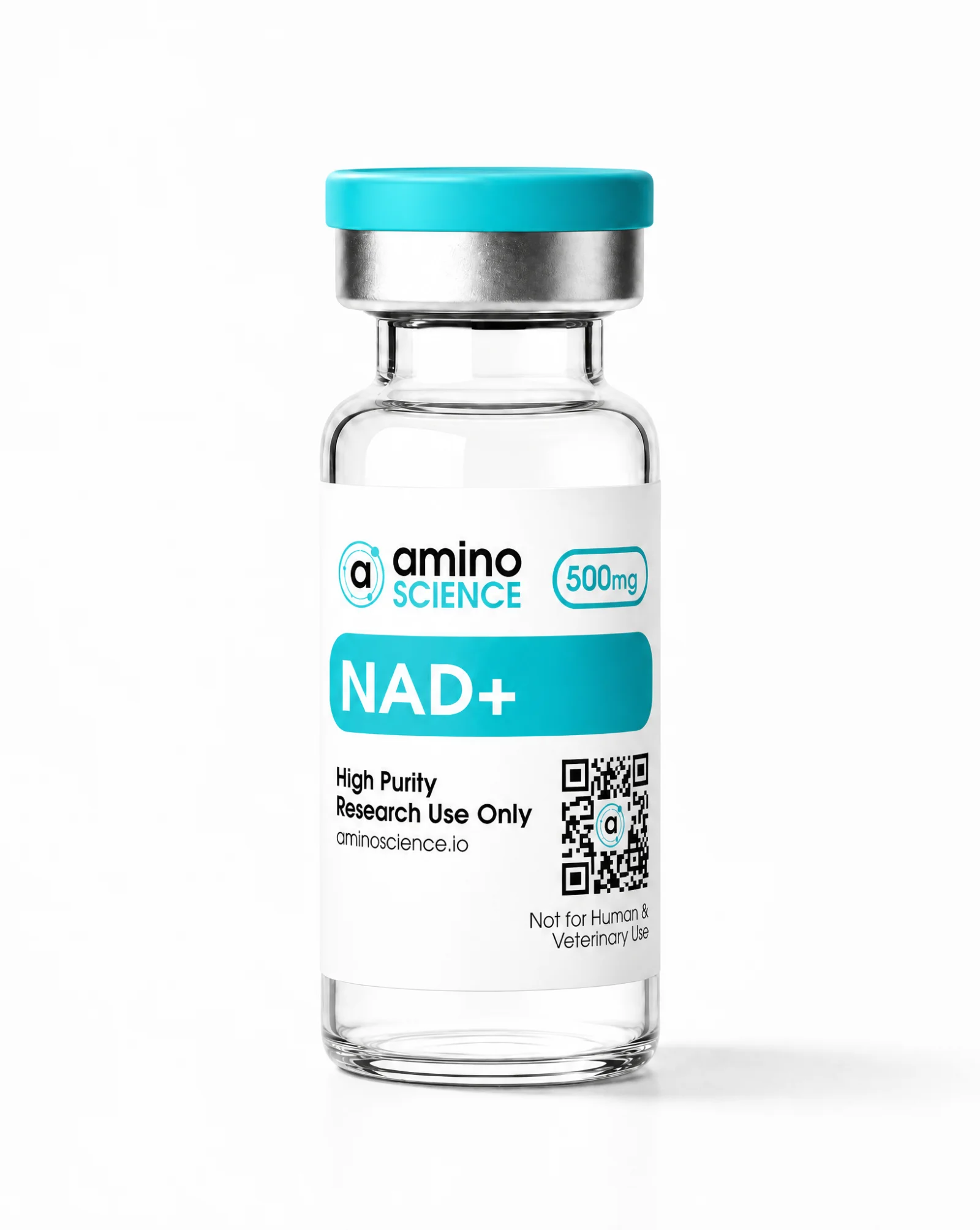
NAD+ exists in cells in two interconverting forms: the oxidized state, written NAD+, and the reduced state, written NADH. This NAD+/NADH pair shuttles electrons between metabolic reactions and sits at the center of energy metabolism in essentially every cell type that has been examined in research settings. A closely related pair, NADP+/NADPH, carries an additional phosphate on the adenosine ribose and participates in a separate set of reductive (biosynthetic and antioxidant-related) pathways studied in the laboratory. In research catalogs, NAD+ is typically supplied as a lyophilized (freeze-dried) white to off-white powder for reconstitution, intended strictly for in-vitro and preclinical investigation.
Beyond its classical role as a redox carrier, NAD+ has become a focal point in metabolism, DNA-repair, and aging-biology research because it is also consumed as a substrate by several families of enzymes. This dual identity, as both a recyclable electron carrier and a consumable signaling substrate, is a major reason the molecule continues to attract attention in laboratory work. This overview summarizes how NAD+ has been characterized in the scientific literature, the enzyme systems studied in vitro, and standard practices for handling research-grade material. It is written for an audience of researchers and is not a guide to any human or animal application.
Research Background
NAD+ was first described in the early twentieth century in studies of fermentation, where it was identified as a heat-stable factor required for yeast extracts to metabolize sugar. Its structure and redox chemistry were characterized over subsequent decades, and it became a textbook cofactor of central metabolism. Interest broadened substantially once researchers identified NAD+-dependent enzyme families that cleave NAD+ rather than merely cycling it, reframing the molecule as a signaling substrate in addition to an electron carrier.
Three enzyme families are most prominent in this literature. Sirtuins (SIRT1 through SIRT7 in mammalian systems) are NAD+-dependent deacylases studied in the context of gene regulation and stress-response signaling. The poly(ADP-ribose) polymerases (PARPs) consume NAD+ during the poly(ADP-ribosyl)ation reactions examined in DNA-damage-response research. CD38 and related ectoenzymes (sometimes described as NADases) hydrolyze NAD+ and are studied as regulators of its availability. Because all three destroy NAD+ as they act, investigators studying cellular metabolism have reported that measured NAD+ pools change across a range of experimental conditions in preclinical models and cultured cells, which has motivated work on how these pools are synthesized, salvaged, and depleted.
Much of the contemporary literature centers on NAD+ biosynthesis and its precursors. In laboratory systems, NAD+ can be generated de novo from the amino acid tryptophan and through salvage pathways that recycle nicotinamide, nicotinic acid, nicotinamide riboside (NR), and nicotinamide mononucleotide (NMN). A body of preclinical and early-stage research has examined whether these precursors change intracellular NAD+ pools in the systems under study; controlled studies have reported that NR and NMN can raise measured NAD+ markers in the samples analyzed, whereas nicotinamide alone was associated with less consistent findings. This precursor work provides context for interpreting studies that use NAD+ itself as a reagent, and researchers describe these precursors as experimental subjects of ongoing study rather than validated interventions.
Mechanism at a Laboratory Level
At the biochemical level, NAD+ operates through two broad mechanisms that are studied largely independently in vitro. The first is reversible and does not consume the molecule; the second cleaves it. Distinguishing between them is useful for researchers designing enzyme assays or metabolic experiments.
Redox cofactor role (NAD+/NADH)
In its redox capacity, NAD+ accepts a hydride ion (a proton with two electrons) at the nicotinamide ring during oxidation reactions, becoming NADH, then donates those electrons elsewhere to regenerate NAD+. This cycling is central to glycolysis, the tricarboxylic acid (Krebs) cycle, and the mitochondrial electron transport chain, where NADH serves as a primary electron donor for oxidative phosphorylation in isolated mitochondria and cell models. Because these reactions regenerate NAD+ without consuming it, the redox pool can, in principle, turn over many times. The reduced form NADH also has a characteristic ultraviolet absorbance near 340 nm that the oxidized form lacks, a spectroscopic difference widely exploited in laboratory enzyme-kinetics assays to follow reactions in real time.
Consuming enzyme-substrate role (sirtuins, PARPs, CD38)
Separately, NAD+ is cleaved as a substrate by NAD+-consuming enzymes, which break the bond between the nicotinamide and the ADP-ribose portion of the molecule. Sirtuins are studied in cell and animal models in relation to protein deacylation, gene-regulatory pathways, and mitochondrial-biogenesis signaling; their catalytic cycle produces nicotinamide and an acyl-ADP-ribose product. PARP enzymes use NAD+ during poly(ADP-ribosyl)ation in DNA-damage-response studies, and laboratory reports note that extensive DNA damage can drive PARP over-activation with measurable NAD+ depletion in experimental systems. CD38 and related ectoenzymes hydrolyze NAD+ and are investigated as major determinants of NAD+ turnover, including in the generation of calcium-signaling metabolites such as cyclic ADP-ribose. Because these enzymes destroy NAD+ as they act, the balance between synthesis, salvage, and consumption is an active area of preclinical inquiry, and no single regulatory model is regarded as fully settled.
What Has Been Studied (Preclinical and In-Vitro)
The published NAD+ literature is broad. The following summarizes categories of research that have been reported in isolated-enzyme, cell-culture, and animal-model systems. None of these represent established outcomes in humans, and they are presented for scientific context only.
Cellular metabolism and mitochondrial regulation: studies in isolated mitochondria and cultured cells examining how NAD+/NADH ratios relate to glycolytic and Krebs-cycle flux, electron-transport-chain activity, and sirtuin-linked signaling.
DNA-repair and genomic-stability models: in-vitro work on PARP activity, poly(ADP-ribosyl)ation, and how NAD+ availability tracks with DNA-damage responses in cell systems.
Sirtuin biochemistry: enzyme-level assays characterizing NAD+-dependent deacylase activity, substrate specificity, and the inhibitory effect of the nicotinamide reaction product.
CD38 and NAD+ turnover: studies characterizing NADase activity and its contribution to declining NAD+ measurements in aged tissue samples from model organisms.
Aging-biology models: preclinical investigations correlating tissue NAD+ measurements with age in animal and human-tissue samples, and interventional studies in model systems using NAD+ precursors such as NMN and NR.
Precursor pharmacology: controlled studies characterizing how NR and NMN change measured NAD+ pools, with researchers framing these precursors as experimental subjects of ongoing study rather than validated interventions.
It is important to emphasize that reviews of this field consistently describe the available evidence as preliminary and mixed. Several early studies reported changes in selected metabolic or functional laboratory measures, while other endpoints were unchanged, and some analyses have noted that raising NAD+ markers did not consistently correspond to changes in the functional endpoints examined. Cross-study comparison is complicated by differences in cell type, species, concentration ranges, and analytical methods. The research is ongoing, and this article is not medical advice.
Interpretation note
The endpoints described above are experimental measurements from isolated-enzyme, cell-culture, and animal-model systems. They are not evidence of any effect in humans, and nothing in this section should be read as a health outcome or a claim about efficacy or safety.
Analytical Characterization: Purity, HPLC, and COA
For any NAD+ research reagent, analytical characterization is central to reproducible results. NAD+ is chemically labile relative to many small molecules: it can degrade under heat, in strongly alkaline conditions, and over time in solution, and preparations may contain related nucleotide impurities or breakdown products. Because of this, identity and purity verification before use is standard practice, and the reported figures directly affect how a researcher interprets an experiment.
High-performance liquid chromatography (HPLC), most commonly reversed-phase or ion-pair HPLC, is the standard technique for assessing chromatographic purity and detecting related-substance impurities. Because both NAD+ and NADH absorb ultraviolet light (NAD+ around 260 nm from the adenine, with NADH adding the diagnostic 340 nm band), UV detection is well suited to the analysis. Mass spectrometry is frequently used alongside HPLC to confirm identity by matching the measured molecular mass to the expected value for the sequence and salt form.
A Certificate of Analysis (COA) accompanying a research lot documents these analyses. Identity matters because two powders can share a label yet differ in salt form, water content, or impurity profile, all of which change the effective amount of active NAD+ per milligram and can confound results. Researchers evaluating material generally review the COA for the following.
Purity: research-grade NAD+ is typically specified at high chromatographic purity, commonly reported at or above 98 percent by HPLC on the COA, with a stated method.
Identity: confirmed by methods such as HPLC retention time, characteristic UV absorbance, and mass spectrometry against the expected molecular weight.
Salt form and net content: whether the material is the free acid or a salt (for example NAD+ disodium), plus any reported water or residual-solvent content, since these determine the true amount of NAD+ present.
Lot-specific documentation: results tied to the exact lot number, with appearance and assay values, so the analysis matches the vial in hand.
Physical form: usually a white to off-white lyophilized powder for laboratory reconstitution.
Standard Laboratory Handling and Storage
The following notes describe conventional handling of lyophilized research material in a laboratory environment. They are provided for material-handling context only and do not imply any human or animal use. NAD+ is more sensitive to moisture, heat, and pH than many small-molecule reagents, so handling practices emphasize keeping the dry powder cold and dry and minimizing time in solution at unfavorable conditions.
Lyophilized storage: freeze-dried NAD+ is generally kept sealed and protected from light and moisture. Long-term storage of the dry powder is commonly maintained at -20 degrees C or colder; consult the supplier COA for the lot-specific recommendation.
Warm before opening: vials are typically brought to room temperature while still sealed before opening, which reduces condensation of atmospheric moisture onto the hygroscopic powder.
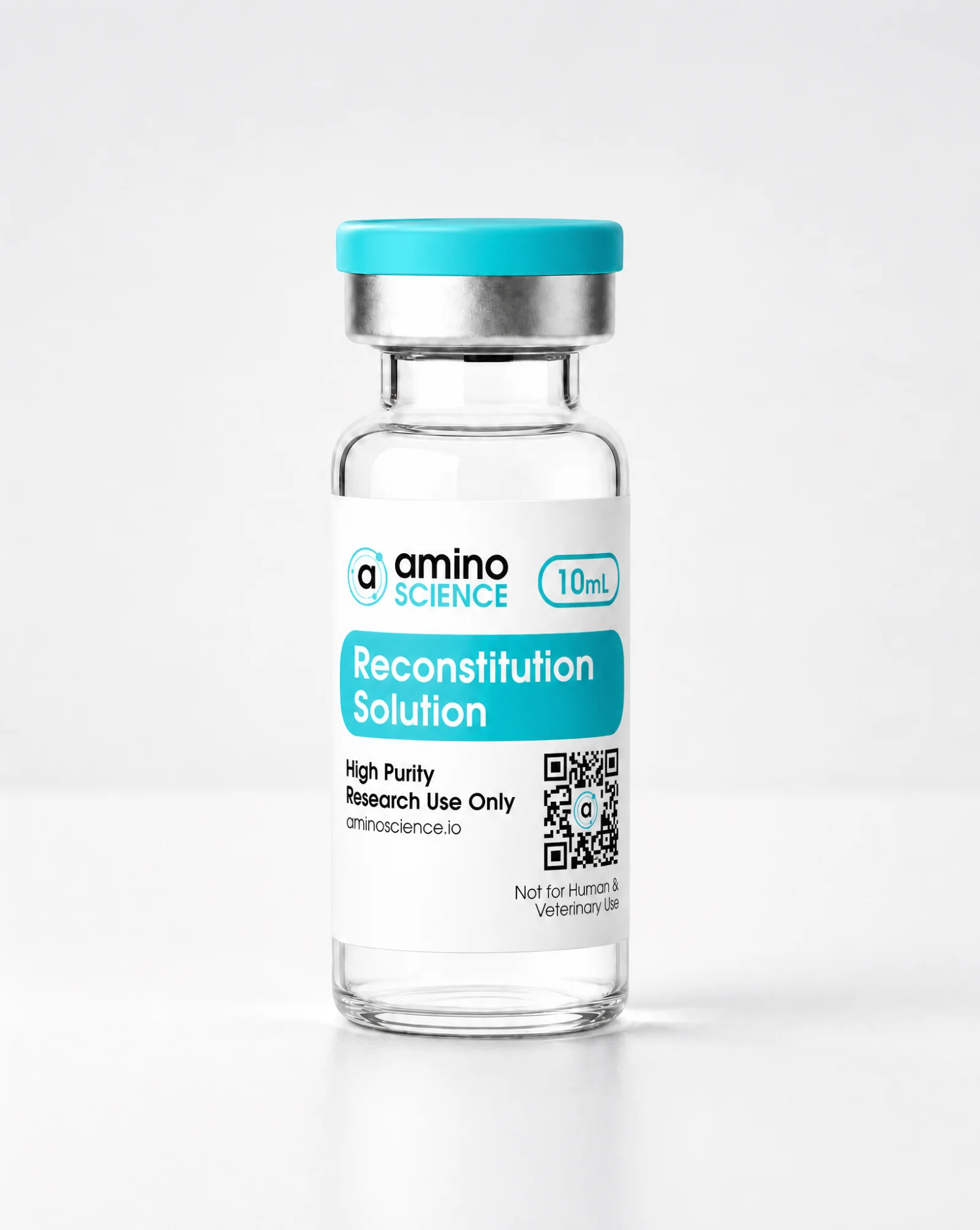
Reconstitution: when an experiment requires a solution, the powder is dissolved in an appropriate laboratory diluent. Sterile or bacteriostatic water is a common aqueous diluent; because NAD+ is less stable at alkaline pH, buffer selection and pH are usually chosen deliberately for the assay.
Aliquoting: reconstituted solutions are often divided into single-use aliquots before freezing to avoid repeated freeze-thaw cycles, which can degrade the reagent and shift measured concentrations.
Reconstituted stability: NAD+ solutions are generally less stable than the lyophilized form, are kept cold, and are used within a limited window; researchers confirm stability empirically for their specific buffer and conditions.
Documentation: recording lot number, salt form, reconstitution date, diluent, and concentration supports reproducibility and traceability across experiments.
Bacteriostatic water, sterile diluents, and reconstitution supplies are handled as general laboratory consumables. As with all research chemicals, appropriate personal protective equipment and institutional safety protocols apply.
Summary
NAD+ is a dinucleotide coenzyme that functions both as a recyclable redox carrier in the NAD+/NADH pair and as a consumable substrate for the sirtuin, PARP, and CD38 enzyme families. These dual roles place it at the intersection of cellular metabolism, DNA-repair biochemistry, and aging-biology research, where it has been studied extensively in isolated enzymes, cultured cells, and animal models. The available evidence is best regarded as preliminary and mixed rather than conclusive. For researchers working with the compound, the most practical considerations are analytical: verifying identity, purity, and salt form against a lot-matched COA, and applying standard cold, dry, low-freeze-thaw handling to preserve a reagent that is more labile than many small molecules.
Frequently asked questions
What is NAD+ in research terms?
NAD+ (nicotinamide adenine dinucleotide) is a dinucleotide coenzyme built from an adenine nucleotide joined to a nicotinamide nucleotide. In research it is studied both as a redox electron carrier (interconverting between NAD+ and NADH) and as a substrate consumed by enzymes such as sirtuins, PARPs, and CD38. It is supplied to laboratories as a lyophilized powder for in-vitro and preclinical research use only, not as a therapeutic product.
What is the difference between NAD+ and NADH?
They are the two forms of the same redox pair. NAD+ is the oxidized form that accepts a hydride ion during oxidation reactions to become NADH, the reduced form; NADH then donates those electrons elsewhere to regenerate NAD+. NADH has a characteristic ultraviolet absorbance near 340 nm that NAD+ lacks, a difference commonly used to follow enzyme reactions in laboratory assays.
Which enzymes consume NAD+ and why does that matter in research?
Three families are studied most: sirtuins (NAD+-dependent deacylases), PARPs (which use NAD+ in DNA-damage-response poly(ADP-ribosyl)ation), and CD38 and related ectoenzymes (which hydrolyze NAD+). Because these enzymes cleave NAD+ rather than cycling it, the balance between NAD+ synthesis, salvage, and consumption is a central experimental question in metabolism, DNA-repair, and aging-biology models.
Has NAD+ been studied in humans?
The mechanistic literature is predominantly from isolated-enzyme assays, cell culture, and animal models. Some early and ongoing studies, often using NAD+ precursors such as NR and NMN, have examined effects on measured NAD+ markers, but reviews generally describe the human evidence as preliminary and mixed, and NAD+ is not established as a therapeutic agent by major regulatory bodies. The material described here is for laboratory research only.
How is research-grade NAD+ verified and stored in a laboratory?
Purity is typically assessed by HPLC (often reported at or above 98 percent) with identity confirmed by UV absorbance and mass spectrometry, all documented on a lot-specific Certificate of Analysis that also states the salt form. Because NAD+ is sensitive to heat, moisture, and alkaline pH, the lyophilized powder is generally stored sealed and dry at -20 degrees C or colder, warmed while sealed before opening, and, once reconstituted, aliquoted and kept cold to limit freeze-thaw cycles. This describes laboratory material handling only.
For research use only. Not for human or veterinary use. This content is educational and summarizes laboratory research; it is not medical advice and makes no health claims.