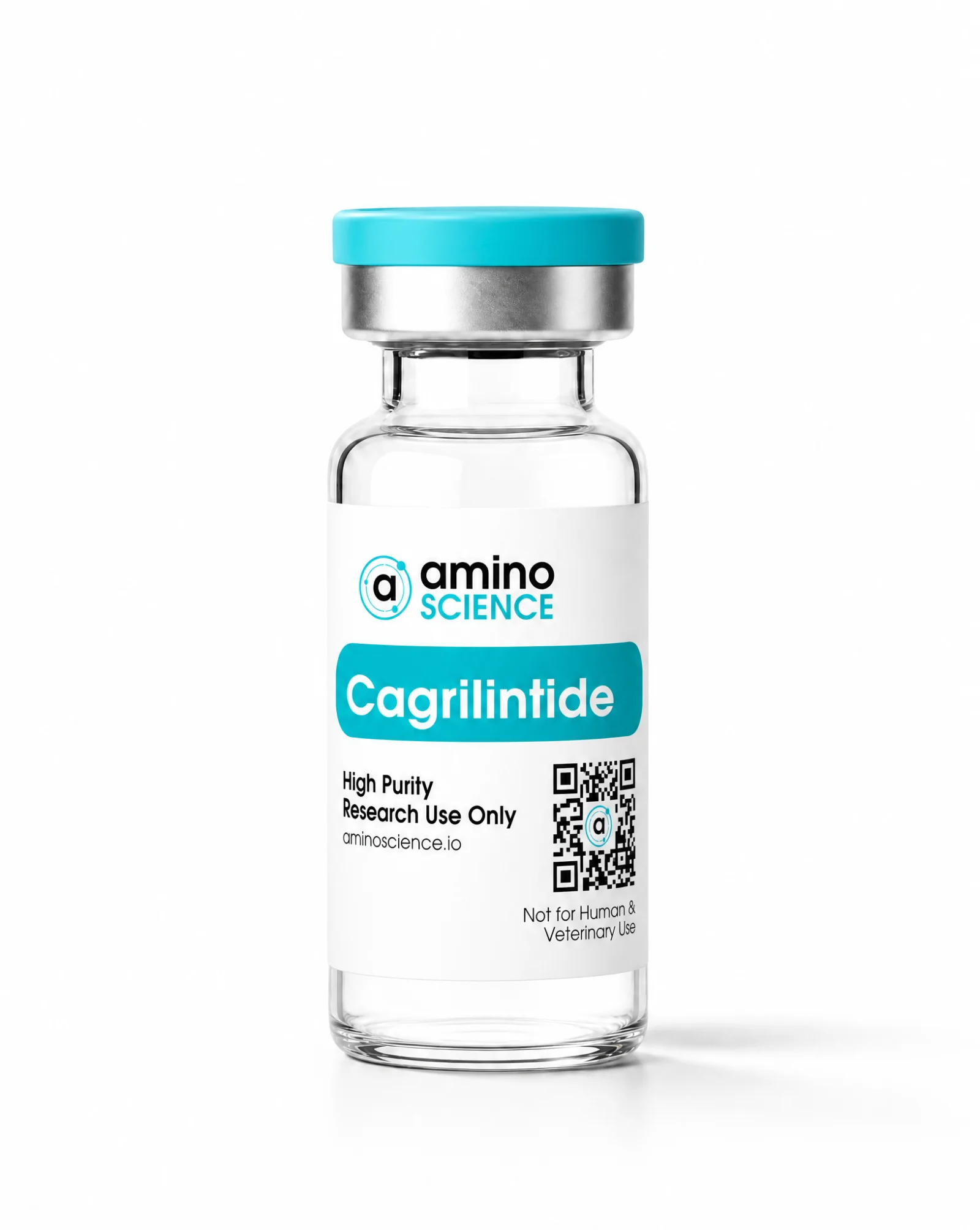
A laboratory reference on the long-acting amylin analog cagrilintide: receptor pharmacology, why lipidation matters, and the handling specifics of a disulfide-containing peptide.
November 7, 2026·7 min read
Research Use Only
This article is provided for educational and informational purposes only and describes laboratory and preclinical research. The compound discussed is a research chemical intended strictly for in-vitro and laboratory research use, and is NOT for human or animal consumption, diagnostic, or therapeutic use. Nothing here is medical advice or a claim of safety or efficacy. The research summarized is preliminary and ongoing; observations in cell cultures or animal models do not establish outcomes in humans.
What Is Cagrilintide?
Cagrilintide (CAS 2171674-71-6, molecular formula C194H312N54O59S2, average mass approximately 4409 g/mol) is a long-acting synthetic analog of amylin, also known as islet amyloid polypeptide. It is a 32-residue peptide built on the amylin scaffold and carrying a fatty-diacid lipidation motif. The two sulfur atoms in its formula correspond to an intramolecular disulfide bridge, a structural feature that has direct consequences for how the material is handled in solution.
In the research literature cagrilintide is encountered as a tool compound for probing amylin-receptor pharmacology, and increasingly in preclinical work examining combined preparations with incretin-class peptides. It is supplied to laboratories as a lyophilized reference material for in-vitro and preclinical investigation only.
Research Background: The Amylin Scaffold
Native amylin is a 37-residue pancreatic peptide that is notoriously difficult to work with as a reagent: the human sequence is highly aggregation-prone and readily forms amyloid fibrils in solution, which is the property that gives islet amyloid polypeptide its name. Much of the medicinal-chemistry history of this class consists of attempts to produce analogs that retain receptor activity while resisting fibrillation. Analog design in this area therefore addresses two problems simultaneously, receptor pharmacology and physical stability, and the resulting sequences differ from native amylin at multiple positions.
Cagrilintide belongs to a later generation of these analogs, in which a fatty-diacid chain was added with the stated aim, in the published pharmacokinetic literature, of extending the molecule's circulating half-life relative to native amylin in laboratory model systems. The acylation strategy parallels that used for long-acting incretin analogs, which is part of why the two classes are frequently studied side by side.
Mechanism at the Laboratory Level
Amylin and its synthetic analogs are studied as agonists at amylin receptor complexes, which are not single proteins but heterodimers: the calcitonin receptor paired with one of three receptor activity-modifying proteins (RAMPs) to produce the AMY1, AMY2, and AMY3 subtypes. Because the calcitonin receptor is a shared component, selectivity between amylin receptors and the calcitonin receptor itself is a standard thing to characterize, and cell-based functional assays measuring cyclic-AMP accumulation in transfected systems are the usual readout.
Reported research directions involving cagrilintide and related lipidated amylin analogs include:
Receptor-binding and functional-agonism assays across the AMY1, AMY2, and AMY3 receptor complexes in transfected cell systems.
In-vitro signal-transduction readouts such as cyclic-AMP accumulation, used to profile the potency and selectivity of the lipidated analog.
Structure-activity and lipidation studies comparing acylated amylin analogs against native peptide to characterize protein-binding and stability behavior.
Combination-preparation research pairing amylin analogs with incretin-class peptides in preclinical models to study additive receptor signaling.
Analytical stability and aggregation studies relevant to handling a cysteine-containing, lipidated peptide in solution.
These describe observations in controlled laboratory systems only and do not establish outcomes in humans or animals.
Combination-Preparation Research
A recurring theme in recent preclinical literature is the pairing of amylin analogs with incretin-class peptides in model systems, on the rationale that the two act through entirely separate receptor families and may produce additive signaling readouts. Laboratories investigating this run matched assays with each peptide alone and in combination to distinguish additive from synergistic behavior. As with all work summarized here, these are observations in controlled laboratory systems and do not establish outcomes in humans or animals.
Purity, HPLC, and the Certificate of Analysis
Two properties of cagrilintide make characterization particularly important. First, the intramolecular disulfide bridge means that correct folding, not just correct sequence, determines whether the material behaves as expected; scrambled or reduced forms have the same nominal mass as the correctly folded peptide and will not be distinguished by mass alone. Second, the lipidation adds synthetic complexity and related-substance potential. Research-grade material is characterized by reversed-phase HPLC for purity and mass spectrometry for identity against the theoretical mass, with the COA also reporting actual fill weight for concentration math.
Standard Laboratory Storage and Handling
Cysteine-containing peptides require attention to redox conditions, since reducing agents in a buffer can cleave the disulfide and alter the peptide's conformation. Aggregation is the other principal concern for anything built on an amylin scaffold, so solutions are generally prepared fresh, kept cold, and inspected for cloudiness or particulate before use. As with other lipidated peptides, the fatty-acid chain increases surface adsorption, and solvent should run slowly down the interior vial wall rather than onto the cake.
Check buffer composition for reducing agents before preparing solutions of any disulfide-containing peptide, and consult the lot Certificate of Analysis for solubility guidance and actual fill weight. This information describes laboratory procedure only and does not describe or imply any human or veterinary application.
Why Disulfide Integrity Is the Governing Variable
Most handling guidance for research peptides concerns keeping the backbone intact. For a disulfide-containing peptide like cagrilintide, there is a second structural requirement that is easier to violate and harder to detect: the intramolecular bridge has to remain formed, and formed between the correct pair of cysteines. A reduced or scrambled peptide retains the same amino-acid composition and the same nominal mass as the correctly folded molecule, so routine mass confirmation will not flag the problem.
The most common way this goes wrong in practice is buffer composition. Reducing agents such as dithiothreitol (DTT) or tris(2-carboxyethyl)phosphine (TCEP) appear routinely in protein-work buffers and will cleave the disulfide. A buffer carried over from an unrelated protocol can therefore silently change the conformation of the peptide before the assay begins. Checking buffer composition for reducing agents before preparing any solution of a cysteine-containing peptide is a cheap precaution against an expensive and invisible failure.
Aggregation: Inspecting Before Use
Anything built on an amylin scaffold carries aggregation risk as an inherited property, even when the analog was specifically engineered to resist fibrillation. The practical consequence is that visual inspection before use is not a formality for this compound class. A correctly reconstituted solution should be clear and free of visible particulate. Cloudiness, visible fibers, or a faint shimmer under angled light all indicate that aggregation has begun, and material in that state should not be carried into an assay, because the effective concentration of monomeric peptide is no longer what the calculation says it is.
Standard mitigations are to prepare solutions fresh rather than storing them, keep them cold, avoid agitation during and after reconstitution, and resist the temptation to redissolve visible aggregate by vortexing, which generally makes the problem worse. Where longer storage is unavoidable, single-use aliquots frozen immediately after preparation avoid the repeated freeze-thaw cycling that stability studies associate with aggregation in this peptide class.
What Remains Under Investigation
Open questions in this area include the precise selectivity profile of lipidated amylin analogs across AMY1 to AMY3 and the calcitonin receptor, the structural determinants that suppress fibrillation without compromising receptor engagement, and the behavior of combined amylin and incretin preparations in matched preclinical systems. The literature on this analog class is comparatively recent, and published observations remain preliminary and ongoing.
Frequently asked questions
What receptors do amylin analogs act on?
Amylin receptors are heterodimers of the calcitonin receptor paired with one of three receptor activity-modifying proteins, producing the AMY1, AMY2, and AMY3 subtypes. Because the calcitonin receptor is a shared component, selectivity between amylin receptors and the calcitonin receptor itself is routinely characterized in cell-based assays.
Why is native amylin difficult to work with as a reagent?
The human sequence is highly aggregation-prone and readily forms amyloid fibrils in solution, which is the origin of the name islet amyloid polypeptide. Much of the analog-design history in this class consists of producing sequences that retain receptor activity while resisting fibrillation.
What does the lipidation on cagrilintide do?
The fatty-diacid motif was engineered, per the published pharmacokinetic literature, with the aim of extending the molecule's circulating half-life relative to native amylin in laboratory model systems. The strategy parallels the acylation used in long-acting incretin analogs.
Why does the disulfide bridge matter for characterization?
Correct folding, not just correct sequence, determines whether the peptide behaves as expected. Scrambled or reduced forms share the same nominal mass as the correctly folded peptide, so mass spectrometry alone will not distinguish them, making the full COA characterization important.
Why are amylin analogs studied alongside incretin peptides?
The two classes act through entirely separate receptor families, so preclinical work pairs them to examine whether combined preparations produce additive signaling readouts. Matched assays with each peptide alone and in combination are used to distinguish additive from synergistic behavior.
For research use only. Not for human or veterinary use. This content is educational and summarizes laboratory research; it is not medical advice and makes no health claims.